Senior Governance Specialist, Leadership for Development Program
Closing Date 29-Nov-2010
Language Requirements English [Essential]; French [Essential]; Spanish [Essential]
Senior Public Sector Specialist
Closing Date 20-Dec-2010
Private Sector Development Off.
Closing Date 20-Dec-2010
Thursday, November 25, 2010

Book Recommendations
Books that have influenced the Austrian Economist;
“Notes on Democracy” By H L Mencken: Wonderfully written. I have never enjoyed anything in the recent past than Mencken’s elitist views. I wonder why I never read him before. He has a deep contempt for the unthinking masses, which I happen to share. He writes, (on the common man): “A politician by instinct and a statesman by divine right, he has never heard of “The Republic” or “Leviathan.” A Feinschmecker of pornography, he is unaware of Freud.”
“How to Develop a Super Power Memory” by Harry Lorayne: I read it when I was 17 and just out of school. I owe my near-photographic memory to this book, among many others. It helped me realize that our mind has several powers which we don’t even know of.
Tuesday, November 16, 2010
For the Young Economist- Technique is Secondary
Glenn Loury on Peter Diamond;
Peter was an inspiration and role model for me during my student years at MIT. My encounters with him -- in the classroom and in his office -- left an indelible impression. I recall going over to the Dewey Library shortly after arriving in Cambridge, in the summer of 1972, and digging out Peter's doctoral dissertation. This was a mistake! Peter's reputation as a powerful theorist had been noted by my undergraduate teachers at Northwestern. I wanted to see how this reputed superstar had gotten his start. Just how good could it be, I wondered? I had no idea! What I discovered was an elegant, profound and exquisitely argued axiomatic treatment of the general problem of representing consumption preferences over an infinite time horizon, extending results obtained by his undergraduate teacher and the future Nobel Laureate, Tjallings Koopmans.
I prided myself on being a budding mathematician in those years. Yet, Peter's effortless mastery in that dissertation of the relevant techniques from topology and functional analysis, and his successful application of those methods to a problem of fundamental importance in economic theory -- all accomplished by age 23, younger than I was at the moment I held his thesis binder in my hands! – was simply stunning. This set what seem to me then, and still seems so now, to be an unapproachable standard. I was depressed for weeks thereafter!
Even more depressing was what I discovered as I got to know Peter better over the course of my first two years in the program: that mathematical technique was not even his strongest suit! An unerring sense of what constitute the foundational theoretical questions in economic science, and a rare creative gift of being able to imagine just the right formal framework in the context of which such questions can be posed and answered with generality -- this, I came to understand, is what Peter Diamond was really good at.
And so, I learned from him in those years what turned out to be the most important lesson of my graduate educational experience -- that, in the doing of economic theory and relative to the behavioral significance of the issue under investigation, technique is always a matter of secondary importance -- neither necessary nor sufficient for the production of lasting insights.
IMF Advice to Solomon Islands on Growth


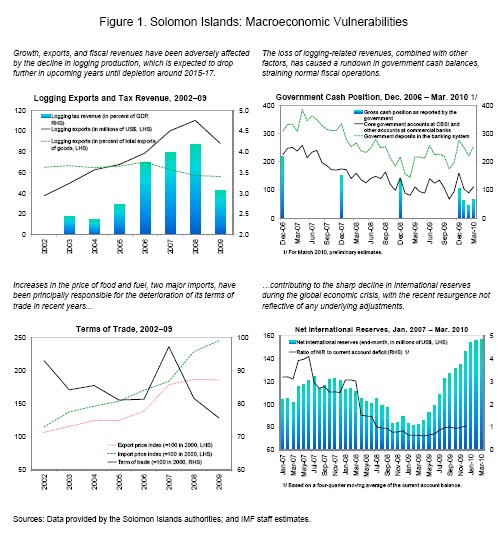
The authorities’ acknowledge that further progress on the agenda of structural reform is needed to strengthen medium-term growth prospects. They intend to build on the steps taken to commercialize operations in stateowned enterprises; improve competitiveness, including the deregulation of telecommunications; and reduce the cost of doing business through revision of the legal framework.
In view of the adverse impact of the global economic downturn, the key objective of the authorities’ economic reform program is to establish a basis for resuming solid growth and reducing external vulnerability in a low-inflation environment, while advancing poverty alleviation efforts. To this end, the program seeks to strengthen the fiscal position, enhance monetary policy operations, and safeguard the domestic financial sector. By laying a strong macroeconomic foundation, the program is also expected to help catalyze additional donor support for the country.
Fiscal discipline will continue to serve as the main anchor for macroeconomic stability. Efforts will focus on rebuilding cash reserves mainly by strengthening revenue collection and prioritizing expenditure. Adopting a fiscal responsibility law and devising a proper resource tax regime would help enhance budget discipline, improve revenue transparency, and ensure a sustainable fiscal path.
“The current monetary stance is broadly appropriate, and sufficiently accommodative to support economic recovery. The program seeks to strengthen the operational framework of monetary policy and introduce new policy instruments to help banks manage liquidity, ensuring long-term price stability.
Binding Constraints for Growth in Solomon Islands
Interesting report on regenerating growth in Solomon Islands-
Related:
Solomon Islands Sources of Growth
Key Findings Summary
The report warns that examples of rapid and sustained economic growth globally are rare. The Pacific Island Countries face particular disadvantages, due to their small size and large distance to major markets. Solomon Islands may face especially severe constraints, as its scattered population reduces access to infrastructure and increases the costs of transport.
"Solomon Islands faces economic challenges, but growth prospects are reasonable if Solomon Islands plays to its existing advantages and capabilities," said Doug Porter, who led the study.
The report states that prospects for economic development in Solomon Islands will be significantly improved if four key potential sources of growth are prioritized. These areas include:
-Increasing productivity in agricultural production, on which most Solomon Islanders will continue to rely
-Ensuring that major natural resource industries - including mining and tourism – are well regulated, so that benefits flow to Solomon Islanders
-Increasing labor mobility, with Solomon Islanders having increased opportunities to acquire skills and incomes from work in Australian, New Zealand and other overseas economies.
-Improving the administration of aid, with more predictable flows of resources and capacity, with mutual accountability for results.
According to the report, economic growth is likely to be concentrated in urban centers, areas of high agricultural production, and areas with natural resource potential.
"However benefits can be shared throughout the country if efforts are made to connect rural populations to urban markets, and carefully target investment in services and infrastructure where economic activity and population are concentrated," said Doug Porter.
Related:
Solomon Islands Sources of Growth
Key Findings Summary
Monday, November 15, 2010
EXCEL Tip of the Day
Summing with error terms:
If you use the normal SUM formula, you will get #N/A. To find out the total of the values, you have to use the SUMIF formula =SUMIF(B2:B10,"<>#N/A"), assuming that the range is from B2 to B10
Assorted Reports
2010 Human Development Report
Land, Environment and Climate Change; Challenges, responses and Tools
Urban Land Markets:Economic Concepts and Tools for engaging in Africa
State of the World Population 2010: from conflict and crisis to renewal: generations of change
Measuring the Information Society
Information Economy Report 2010: ICTs, Enterprises and Poverty Alleviation
Economic Diversification in Africa: A Review of Selected Countries
World Economic Outlook : Recovery, Risk and Rebalancing October 2010
Trends in Sustainable Development – Small Island Developing States 2010-2011
2010 World Social Science report
eAtlas of the Millennium Development Goals
Financial Access Report 2010: the state of financial inclusion through the crisis
Charting the progress of the millennium development goals in the Arab Region: a statistical portrait
2010 Global Education Digest
Trade and Development Report 2010: Employment, globalization and development
World Trade Report 2010: Trade in natural resources
Global Employment Trends for Youth 2010
World Investment Report 2010:Investing in a low-carbon economy
Land Inventory in Botswana: Processes and Lessons
Philippines - Study on agribusiness, infrastructure, and logistics for growth in Mindanao : policy note
Poland - Public land and property asset management in Warsaw : strategic opportunities
Afghanistan - Scoping strategic options for development of the Kabul River Basin : a multisectoral decision support system approach
China - Concessionary financing programs for the water and sanitation sector : policy note
Effective discipline with adequate autonomy : the direction for further reform of China's SOE dividend policy
Syrian Arab Republic - Electricity sector strategy note
Niger - Towards an integrated and sustainable pension system
Solomon Islands growth prospects : constraints and policy priorities
Vietnam development report 2010 : modern institutions
Cambodia - Sustaining rapid growth in a challenging environment : country economic memorandum
Tunisia - Development policy review : towards innovation-driven growth
Education, training, and labor market outcomes for youth in Indonesia
Pakistan - City development strategy for Peshawar
Serbia - Right-sizing the government wage bill
Malaysia economic monitor : repositioning for growth
Peru - Rethinking private sector participation in infrastructure
South Africa - Enhancing the effectiveness of government in promoting mcro, small and medium enterprise
Strengthening Caribbean pensions : improving equity and sustainability
Kosovo - Youth in jeopardy : being young, unemployed, and poor in Kosovo - a report on youth employment in Kosovo
Armenia - Public financial management reform priorities
Friday, November 12, 2010
Book Recommendation- Growth and Natural Resource exploitation

Edward B. Barbier, University of Wyoming
Throughout much of history, a critical driving force behind global economic development has been the response of society to the scarcity of key natural resources. Increasing scarcity raises the cost of exploiting existing natural resources and creates incentives in all economies to innovate and conserve more of these resources. However, economies have also responded to increasing scarcity by obtaining and developing more of these resources. Since the agricultural transition over 12,000 years ago, this exploitation of new 'frontiers' has often proved to be a pivotal human response to natural resource scarcity. This book provides a fascinating account of the contribution that natural resource exploitation has made to economic development in key eras of world history. This not only fills an important gap in the literature on economic history but also shows how we can draw lessons from these past epochs for attaining sustainable economic development in the world today.
iSimulate
Some cool new stuff from the World Bank.
iSimulate is a platform for performing collaborative economic simulations across the Internet.
ADePT
ADePT was developed to automate and standardize the production of analytical reports. ADePT uses the micro-level data from various types of surveys, such as Household Budget Surveys, Demographic and Health Surveys, Labor Force surveys and others to produce rich sets of tables and graphs for a particular area of economic research.
PovcalNet
PovcalNet is an interactive computational tool that allows you to replicate the calculations made by the World Bank's researchers in estimating the extent of absolute poverty in the world
Monday, October 25, 2010
What's Job Generating Growth
Economic Prospects for Middle East, North Africa and Afghanistan and Pakistan (MENAP).
The report recommended that policymakers in MENAP’s oil importers focus on the following priorities:
• Raising growth to generate employment. During the past two decades, per capita growth among the oil importers has been substantially lower than in other emerging markets, mirroring a weak trade performance (see Chart 2). Faced with already high unemployment—an average of 11 percent in 2008—the challenge for the oil importers will be to raise growth to provide employment for a working age population that is growing faster than in almost all other regions. To absorb the currently unemployed and new labor market entrants over the next decade (and assuming that the ratio of jobs created to economic growth remains constant), annual growth would need to reach 6½ percent.
• Enhancing competitiveness. MENAP oil importers—many of which face burdensome regulatory systems, weak institutions, and a dominating public sector—have much to accomplish to become competitive relative to other more dynamic economies. Sound macroeconomic policies—in particular, fiscal consolidation—will help support competitiveness, but governments will also need to make greater efforts to improve the business climate.
• Fostering trade. The region’s trading patterns remain oriented mainly toward Europe, and there has been relatively little change in the product mix. Although there has been some diversification of trade links, the region has benefited relatively little from the expansion of Asian and Latin American powerhouses—which contribute close to half of global GDP growth, but account for only about 9 percent of the region’s total exports.
Wednesday, September 22, 2010
New Blogs on Development
Added a few new blog finds to the feeds;
Chandan Sapkota's blog;
Development Horizons from Lawrence Haddad
Economics, my dear Watson- recommended, reasonably good blog.
Chandan Sapkota's blog;
I am interested in development economics, economic growth, and economic policy. Apart from blogging, I also write op-eds focusing on economic growth and public policy pertinent to the Nepali economy
Development Horizons from Lawrence Haddad
Economics, my dear Watson- recommended, reasonably good blog.
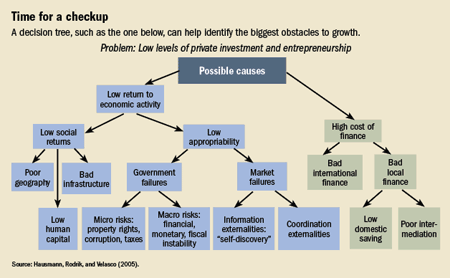
El Salavador's Eternal Binding Constraints
Perhaps the most telling indicator that El Salvador is not constrained by a lack of savings is that a dramatic boost in remittances has not been converted into investment. This suggests that the country invests little, not because it cannot mobilize resources (though savings are low) but because it cannot find productive investments.
IMF latest review of El Salvardor economy;
Over the longer term, further strengthening the economy’s growth prospects and reducing poverty, while safeguarding fiscal sustainability, requires a comprehensive strategy, including measures to raise revenues, structural reforms aimed at enhancing the business climate, and higher private investment...
The authorities’ strategy for 2011, which includes strengthening tax administration to increase revenues as well as reforming energy subsidies, will create space for high-priority social spending and public investment while lowering the fiscal deficit to 3.5 percent of GDP.
“Beyond 2011, timely enactment of a fiscal pact, which includes measures to raise revenue on a durable basis, and continued adherence to expenditure targets in the authorities’ program will be critical to sustain fiscal consolidation, placing the debt-to-GDP ratio on a firm downward path.
“Continued commitment to the dollarization regime has been the cornerstone of macroeconomic and financial stability. While the Salvadoran banking system is liquid and well-capitalized, it would benefit from further reforms aimed at enhancing its resilience. Approving the Financial Sector Supervision and Regulation Law, bolstering the corporate governance of banks, and upgrading the bank resolution framework will be key to this objective. Limiting the fiscal risks associated with the provision of credit by public banks will also be necessary,” Mr. Shinohara said.
Tuesday, September 21, 2010
Quote on Unemployment

Related Podcast;
de Botton on the Pleasures and Sorrows of Work
At one point in book lovely parallel between an Edward Hopper painting and a woman at work writing a marketing study. Hopper really tried to force the eye to notice a lot of that--the industrial life, the unseen, quiet moments of daily existence, not cathedrals or great landmarks. Lots of pictures of paintings of corners of things. Help us see some of the things we are looking at. Hopper classic example. Can't be an American today in many situations without that word "Hopperesque" coming to mind. Be it the late-night motel, the bar, the diner, whatever, we'll be in the footsteps of this great painter. Art is putting post-it notes on parts of the world going, Notice this. Your book is a tourist guide to some of the aspects of modern work.
Monday, September 20, 2010
Technologies Drive Growth, Rules Drive Development
A summary of comments by Paul Romer on development and growth at USAID conference-
Listen to the discussion
Initially, he was first asked to speak about Aid Effectiveness but he wanted to talk about effective comparative to what. He thinks we should still be realistically ambitious and part of that is to look at best successes – China and development of US, including the expansion of the US frontier.
In his view, the key element regarding China’s development as well as the history of US lies in the concept of norms and rules. (He chooses not to use the words governance and institutions as they sometimes have certain connotations).
First, he outlined the difference between the sharing of ideas versus objects. Ideas are non rival compared to objects which are finite. Objects are finite - the more people around the fewer objects for each. However with ideas, the more people, the more ideas are developed. So the non rivalry of ideas and the power that comes from sharing amongst each other is inherent in successes of globalization, urbanization, and communication networks. The discovery and sharing of ideas helps countries that were behind, to catch up economically and developmentally.
He then linked ideas with the development of rules and used the example of Mauritius where a change of rules helped with rapid expansion of economic growth. If you can change rules, technology transfer can be done more quickly which supports economic growth. China has experienced that same dynamic – a change in rules led to special zones, foreign investment, increased expertise, a dramatic increase in manufacturing and rapid increase in economic growth and income. He posits that the puzzle of development needs to be framed around persistent stagnation – growth isn’t surprising, but stagnation is. Why do inefficient rules and ideas persist, limiting growth?
Then, he discussed formal versus informal rules, whereby formal rules are enforced through laws and informal ones are cultural, decentralized, and socially based. Informal laws are flexible and can lead to multiple equilibriums – what your norms are of right and wrong are based on what you see around you. All kinds of rules are enforced by informal norms. Norms can be functional at one point that become dysfunctional later – for example, norms regarding sharing versus norms of individual responsibility and work. But norms are very hard to change. So the answer to why rules can be so wildly inefficient for so long, although could sometimes change, has to do with the stability of norms.
Economists are much too ready to assume rules that are once and done – establish laws and then you’re done. But rules might need to change over time. Need new rules based on new technologies. Another driver of change is scale – rules and social norms that were designed for a small group of people and with scale you now need formal rules and then enforcement. So need to think about “metarules” – what are the rules for when you need to change the rules.
Norms are socially determined, as well as based on persuasion and the educational system. Efficient rules depend on the technologies, patterns of interaction, and distribution of norms in a population. Substitution between formal and informal rules depends on the norms that exist in different parts of the world – so formal rules aren’t always universal. Dynamics of informal rules and norms can trap groups making the shift to new rules and processes difficult. You see this in the business world where large corporations often can’t be as flexible as a startup – they are stuck with older norms that are harder to shift.
Executive action can change norms – i.e. the anticorruption commission created in Hong Kong, which was coupled by anticorruption campaign. It undermined corruption as an accepted norm. But how do you translate this to other contexts?
One way is to focus upon start ups and new norms. The notion of a start up is an important metarule – new initiatives have a chance to set up fresh and good norms. You can create a new set of norms among people who share your concepts, create a model and then acculturate the newer people to follow these standards, thus expanding the norms and rules outward.
This theory is behind his assertion that new Charter Cities can be an important development tool. Romer feels it would be possible to create hundreds of cities that are set up with new norms, special zones where new rules can be implemented, so you can recreate what happened in the US when it was developing and expanding its frontier. That situation, the new US cities attracted outsiders through opportunities and services. One can replicate this success by creating a competition of new cities, such as having hundreds of Dubais, where there would be competition for better living standards. The timing is ripe for this method as the world continues to urbanize currently – once the world’s population stabilizes and people stop moving into new cities, this start up concept will no longer be possible. So we need to look at meta rules beyond just voting, but start ups and other ways to affect norms which impact economic growth and development.
Listen to the discussion
Friday, September 17, 2010
Cyprus Economy Watch
IMF releases Article IV review of Cyprus;
Background. Economic conditions have stabilized, and the economy is projected to bottom out in 2010, giving way to a mild recovery in 2011 followed by stronger growth. However, global financial risks remain elevated and muted growth prospects in trading partners weigh on the outlook. The government has taken steps to stabilize the fiscal deficit, but further measures will be needed to reach the official deficit target for 2012 of 3 percent of GDP.
Challenges and staff views. The foremost policy challenge is to achieve the official fiscal consolidation targets so as to put debt ratios on a declining path and provide more space to guard against risks to the financial sector. Further old-age pension reform is also essential. Preserving financial sector stability through early detection of risks remains a top priority in light of the difficult economic and financial environment, and the supervision of cooperative credit societies needs to be strengthened as a matter of urgency. Structural reforms are needed to preserve competitiveness and enhance medium-term growth.
Authorities’ views. The government largely shared the staff’s assessment, while projecting growth to turn positive as soon as 2010 and being more confident that the fiscal targets can be met through general spending restraint and with less focus on the public payroll. The Central Bank of Cyprus (CBC) expressed confidence in the ability of banks to withstand pressures, and this is supported by stress test results. Moving to a single independent supervisor for all credit institutions—a much desirable objective—is not on the political
agenda, but strengthening the supervision of cooperative credit societies seems feasible.


Tuesday, September 14, 2010
Friday, September 3, 2010
Mankiw and Arnold's Freshmen Seminar
Mankiw's list;
Arnold Kling's list;
1. Jerry Muller, The Mind and the Market.
2. Robert Frank The Economic Naturalist.
3. Carl Shapiro and Hal Varian, Information Rules.
4. Matt Ridley, The Rational Optimist.
5. Kevin Lang, Poverty and Discrimination.
6. Ed Leamer, Macroeconomic Patterns and Stories.
7. Burton Malkiel, A Random Walk Down Wall Street.
8. Tyler Cowen, The Age of the Infovore.
The Worldly Philosophers, by Robert Heilbronr
Reinventing the Bazaar: A Natural History of Markets, by John McMillan
Thinking Strategically, by Avinash Dixit and Barry Nalebuff
Capitalism and Freedom, by Milton Friedman
Equality and Efficiency: The Big Tradeoff, by Arthur Okun
Nudge, by Richard Thaler and Cass Sunstein
How the Economy Works, by Roger E.A. Farmer
The Return of Depression Economics, by Paul Krugman
The Road to Serfdom, Friedrich Hayek
The Myth of the Rational Voter, by Bryan Caplan
The Big Questions, by Steven Landsburg
Arnold Kling's list;
1. Jerry Muller, The Mind and the Market.
2. Robert Frank The Economic Naturalist.
3. Carl Shapiro and Hal Varian, Information Rules.
4. Matt Ridley, The Rational Optimist.
5. Kevin Lang, Poverty and Discrimination.
6. Ed Leamer, Macroeconomic Patterns and Stories.
7. Burton Malkiel, A Random Walk Down Wall Street.
8. Tyler Cowen, The Age of the Infovore.
Thursday, September 2, 2010
A Must Read Book

Howard Wainer
Related:
According to Diane Coyle;
This marvellous book by Howard Wainer, Picturing the Uncertain World: How to Understand, Communicate and Control Uncertainty through Graphical Display, is an absolute must for anyone who claims to be involved in the search for empirical evidence. It's a sequel to the same author's Graphic Discovery and also in the tradition of Edward Tufte's The Visual Display of Quantitative Information. All applied economists should have read carefully all three books and keep them close by for reference. So should all other researchers - social science, medicine, education - anybody who needs to navigate the shoals of carrying out robust empirical work and communicating it to others.
Picturing the Uncertain World : Summary
;
Three principles of effective display are mentioned that can be called “THREE COMMANDMENTS of effective data display of data”
1. Remind us that the data being displayed do contain some uncertainty , and then
2. Characterize the size of that uncertainty as as it pertains to the inferences we have in mind , and in so doing
3. help keep us from drawing incorrect conclusions through the lack of a full appreciation of the precision of our knowledge.
Tuesday, August 31, 2010
Two Book Recommendations

Related:
Predicting the Financial Crisis: A Q&A With Fault Lines Author Raghuram Rajan
Sunday, August 29, 2010
Friday, August 27, 2010
Tuesday, August 10, 2010
Assorted
RBI on India and the Global Financial Crisis
The Report on Currency and Finance 2008-09 published by the Reserve Bank of India this month is on the “Global Financial Crisis and the Global Economy.” Well over two-thirds of this 380 page report is about the global crisis itself and does not contain anything new. But about a hundred pages are devoted to the impact of the global crisis on India and to the policy responses in India.
"The High Price of Motherhood"
What Social Science Does—and Doesn’t—Know
Notes from the Field: Comparing Three Villages in Madhya Pradesh
When Labor Is Capital: The Limits of Keynesian Policy
Sunday, August 1, 2010
Lack of Self Discovery in Italy
An interesting piece on problems with Italian economy;
Study the numbers and you will find symptoms of distress that look a lot like those of Greece. Public sector debt amounts to roughly 118 percent of the gross domestic product, nearly identical to Greece. And like Greece, Italy is trying to ease fears in the euro zone and elsewhere with an austerity package, one intended to cut the deficit in half, to 2.7 percent of G.D.P., by 2012.-Is Italy Too Italian?
But dig a little deeper and the similarities end. The Italians, unlike the Greeks, are born savers, and much of the Italian debt is owned by the Italians. That means that unlike Greece, which will be sending a sizable percentage of its G.D.P. to foreign creditors for a generation to come, Italy is basically in hock to its own citizens.
“I know that in the States, all Mediterranean countries get lumped together,” says Carlo Altomonte, an economist with Bocconi University in Milan. “But Italy’s problem isn’t that we have a lot of debt. It’s that we don’t grow.” ...
But sales for Luciano Barbera clothing and Carlo Barbera fabric have drastically slowed in recent years. In the late ’90s, the mill enjoyed record annual sales of what amounts to about $15.5 million, Mr. Barbera says. Last year, the figure was half that sum.
WHEN describing the ills of his businesses, Mr. Barbera tends to focus on one issue: the “Made in Italy” label. For the last decade, he says, a growing number of clothing designers have been buying cheaper fabric in China, Bulgaria and elsewhere and slapping “Made in Italy” on garments, even if those garments are merely sewn here.
Until recently, there weren’t any rules about what “Made in Italy” actually meant, but that will change when a new law goes into effect in October. It states that if at least two stages of production — there are four stages altogether — occur in Italy, a garment is made in Italy....
To understand why his factory, and so much of Italy, is stagnant or worse, requires a bit of geopolitical history and a look at the highly idiosyncratic business culture here. It is defined, to a large degree, by deep-seated mistrust — not just of the government, but of anyone who isn’t part of the immediate family — as well as a widespread aversion to risk and to growth that to American eyes looks almost quaint...
FIVE years ago, Francesco Giavazzi needed a taxi. Cabs are relatively scarce in Milan, especially at 5 a.m., when he wanted to head to the airport, so he called a company at 4:30 to schedule a pickup. But when he climbed into the cab half an hour later, he discovered that the meter had been running for more than 20 minutes, because the taxi driver had arrived soon after the call and started charging for his time. Allowed by the rules, but to Mr. Giavazzi, utterly unfair.
“So it was 20 euros before we started the trip to the airport,” recalls Mr. Giavazzi, who is an economics professor at Bocconi University. “I said, ‘This is impossible.’ ”
Professor Giavazzi later wrote an op-ed article denouncing this episode as another example of the toll exacted by Italy’s innumerable guilds, known by several names here, including “associazioni di categoria.” (These are different from unions, another force here, in that guilds are made up of independent players in a trade or profession who have joined to keep outsiders out and maintain standards, as opposed to representing employees in negotiations with management, as a union might.) Even baby sitters have associations in Italy.
The op-ed did not endear Professor Giavazzi to the city’s cab drivers. They pinned leaflets with his name and address at taxi stands around Milan and for the next five nights, cabs drove around his home, honking their horns.
“This is a country with a lot of rents,” says Professor Giavazzi, sitting in his office one recent afternoon, using the economists’ term for excess profits that flow to a business because of a lack of competition. “You need a notary public, it’s like 1,000 euros before you even open your mouth. If you’re a notary public in this country, you live like a king.”...
Roughly one-quarter of Italy’s G.D.P. is off the books. When you inquire about the cause and persistence of this longstanding fact of life, people here say that most Italians have little sense of national identity, an obstacle to a system of national taxation. The country didn’t really begin to transcend its clannish roots and regional dialects until after World War II; even today, displays of national pride are reserved for World Cup victories and little else.
Italians, notes Professor Altomonte, are among the world’s heaviest consumers of bottled water. “Do you know why? Because the water in the tap comes from the government.”...
The suspicion of Italians when it comes to extra-familial institutions explains why many here care more about protecting what they have than enhancing their wealth. Most Italians live less than a mile or two from their parents and stay there, often for financial benefits like cash and in-kind services like day care. It’s an insularity that runs all the way up to the corporate suites. The first goal of many entrepreneurs here isn’t growth, so much as keeping the business in the family. For a company to really expand, it needs capital, but that means giving up at least some control. So thousands of companies here remain stubbornly small — all of which means Italy is a haven for artisans but is in a lousy position to play the global domination game...
To Professor Giavazzi, the future here doesn’t look like Greece. It looks like Argentina.
“Before World War II, Argentina was rich,” he says. “Even in 1960, the country was twice as rich as Italy.” Today, he says, you can compare the per capita income of Argentina to that of Romania. “Because it didn’t grow. A country could get rich in 1900 just by producing corn and meat, but that is not true today. But it took them 100 years to realize they were becoming poor. And that is what worries me about Italy. We’re not going to starve next week. We are just going to decline, slowly, slowly, and I’m not sure what will turn that around.”
Subscribe to:
Posts (Atom)