Showing posts with label Economic Growth. Show all posts

Friday, March 25, 2011

Seven Wisdoms on the Sri Lankan Economy

Koshy Mathai, the highly-respected and much-sought-after IMF Resident Rep in Sri Lanka left the audience with seven points of his wisdom to ponder if Sri Lanka is to sustain its current euphoric growth experience...

The IMF and its staff have a remarkable skill in using a specially articulated polite language when it comes to addressing a host country’s general public. This is understandable because the IMF is a guest in a host country and should not overtly or covertly rouse popular sentiments or add to the fears of people by speaking the wrong language and be an embarrassment to its host...

Risk factors need urgent attention
Koshy did not say it explicitly, but he implied that the achievements so far are not adequate for sustaining the growth momentum in the medium to long run. He coated it nicely saying that there are “risk factors” facing the economy and they need be addressed urgently and permanently.
In my view, his implication was that the longer Sri Lanka would delay action, the worse would be the results it will have to reap. It is like a cancer patient refusing stubbornly to take medication in time and one fine day finding the cancer invading his vital systems.
To overcome these risk factors and place the economy in a sustainable growth path, he suggested a course of action that embodied the seven points of his wisdom...

One should not forget that the IMF benchmarks are too liberal and were revised upward when it found that it was the only way to save the stand-by arrangement.
Its budget deficit at seven per cent and debt level at 80 per cent, both of GDP, are unsustainable. Therefore, in the long run, there is no alternative but to discipline the budget, as now identified by Koshy too...

In this context, according to Koshy, the Government’s recognition of the need for developing five hubs in Sri Lanka is an important step taken toward the modernisation of the country’s economy.
While all hubs will help Sri Lanka to expand its services sector and sell services to the rest of the world, the knowledge hub will develop Sri Lanka’s human capital base. The early signing of CEPA with India will help Sri Lanka to develop its knowledge base by establishing higher academic institutions in the style of reputed Indian institutes of Technology with Indian partnership.

-Want to uplift the economy? Follow the 7 wisdoms of Koshy Mathai

Friday, January 28, 2011

Book Forum- The Great Stagnation

Tyler Cowen's The Great Stagnation;

I’m also persuaded by the median income numbers because they are supported by related measurements of other magnitudes. For example, another way to study economic growth is to look not at median income but at national income, gdp, or gross domestic product, the total production of goods and services. Charles I. Jones, an economist at Stanford University, has “disassembled” American economic growth into component parts, such as increases in capital investment, increases in work hours, increases in research and development, and other factors. Looking at 1950–1993, he found that 80 percent of the growth from that period came from the application of previously discovered ideas, combined with heavy additional investment in education and research, in a manner that cannot be easily repeated for the future. In other words, we’ve been riding off the past. Even more worryingly, he finds that now that we are done exhausting this accumulated stock of benefits, we are discovering new ideas at a speed that will drive a future growth rate of less than one-third of a percent (that’s a rough estimate, not an exact one, but it is consistent with the basic message here). It could be worse yet if the idea-generating countries continue to lose population, as we are seeing in Western Europe and Japan.

We will be discussing about the book for the next few weeks.

Saturday, January 15, 2011

Trinidad and Tobago- Dual Economy Growth Diagnostic

In the case of a dual, natural resource abundant economy such as Trinidad & Tobago’s, an aggregate view is not enough to understand the growth opportunities and binding constraints: we need to stress the growth opportunities of each sector and their interactions, since the
constraints may be different for non-energy and energy activities.

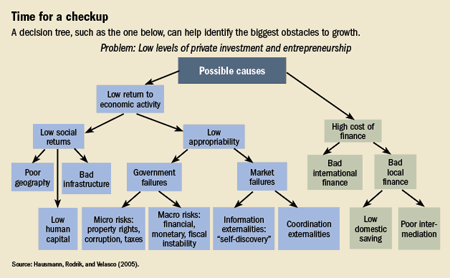
A major concern for Trinidad & Tobago is the diversification of economic activity, and preparing for the time when oil and gas reserves are depleted. The binding constraints to growth in the non-energy sector in Trinidad & Tobago are outlined in the following growth diagnostic tree. The rest of this work will attempt to identify which of these potential constraints to growth are binding.
-Trinidad & Tobago: Economic Growth in a Dual Economy

Belize Economic Outlook

IMF reviews Belize economy;

Key recommendations. Staff recommended a gradual increase in the primary surplus to 4½ percent of GDP, mainly through wage and pension reforms, to place the public debt on a firm downward path and reduce external financing needs. It also recommended continued actions to strengthen the financial system and welcomed improvements in the monetary policy framework. The authorities broadly agreed with the recommendations, particularly tostrengthen the banking system. They planned to seek consensus on needed fiscal reforms, but noted that, in the near term, social conditions strictly constrained the scope for fiscal consolidation.

The authorities seek to reinvigorate growth prospects and reduce the poverty
rate to 35 percent by 2013
. The development plan for 2010–13 focuses on job creation and identifies sources of growth in tourism, agro-industry, and fishing. It rests on five pillars: developing small enterprises; strengthening export trade capacity; enhancing human development; addressing social dislocations and reducing crime; and managing environmental and natural disaster risk. The plan seeks to strengthen competitiveness by addressing infrastructure bottlenecks, high costs of financing, and red tape. It contains investment and social plans that will be assessed and integrated into the multiyear budget and presented to donors later this year.

Friday, December 17, 2010

India and Kenya- IT sector comparision

There is a broad agreement that several key factors determine competitiveness in IT/BPO:(i)availability of employable skills(including IT skills), (ii) competitive costs,(iii)quality of infrastructure relevant to the IT/BPO industry,and(iv)and overall environment that is conducive to business. Of all these factors, countries can substantially increase their international competetive advantage if they execute smart strategies to increase their skills offering for the industry.

Given these developments, the lack of skills is now the most important binding constraint to the growth of the IT/BPO sector in Kenya. The country currently produces around 30,000 university graduates and about 250,000 graduates from high school annually. However, very few of these graduates, whether at school or university level, are immediately suitable for employment in the IT/BPO industry. According to the recent McKinsey Report (2008), the talent pool for the BPO sector in Kenya currently is very limited. Only about 5,000 graduates are suitable for employment in the industry. The report has projected the skills required for BPO sector to be 70 percent for voice and data operators, 5 percent for managers, 10 percent for engineers and 15 percent for technicians

Source: World Bank, Kenya Economic Update

Related:
Location Readiness Index

Monday, December 6, 2010

The United States as a Job Creation Machine- IMF in 1997

The United States as a Job Creation Machine: an Example for Germany?
Characteristics of the U.S. Labor Market compared with Germany
Comparing the German and U.S. labor markets will shed some light on the large differences in job creation, despite similar technology and external conditions. In the United States enterprises and workers respond directly to market incentives:

-the government and union presence in the labor market is more limited
-wage determination is less centralized and developments are guided by market forces; there is little emphasis on incomes policies
-social welfare benefits are not as generous, they are available for relatively short periods, and they are designed to give incentives for recipients to search for new and better job opportunities
-and the wedge between gross wages and take-home-pay, caused by income taxes and social security contributions, is much smaller.

In the tradeoff between allocative efficiency and distributional equality, the United States has emphasized allocative efficiency, while Germany has placed more stress on equity as a cornerstone of the Soziale Marktwirtschaft model. But the U.S. system provides both firms and individuals equal access to the market place and the economic opportunities that are available. The U.S. system stresses the incentives for individual initiative and responsibility for one's economic well-being--that is, rewards to innovation, risk taking, and investment in oneself (i.e., human capital). The social safety net attempts to limit the downside risks associated with this system but not to eliminate inequality of outcomes. From a European perspective, it is interesting that the vast majority of Americans do not question their economic system.

Saturday, December 4, 2010

Bosnia and Herzegovina: Selected Issues

Bosnia and Herzegovina: Selected Issues

Contents
  1. Post-Crisis Growth Prospects And Supporting Policies
  2. External Sector Stability and Competitiveness
  3. Cyclical Developments And Fiscal Policy Design
  4. The Case for Pension Systems Reform

Thursday, December 2, 2010

The India Story told by IMF MD

Let me mention just two powerful features of India’s success story that hold important lessons for other countries.

First, a focus on inclusive growth. In India, the goal is not simply for growth to be rapid, but for growth to also be inclusive—and improve the quality of life for all citizens. As India’s government seeks the best policies to achieve this dual goal, it is fortunate in having advisers like Professor Basu, who brings such strong academic credentials to his position as Chief Economic Adviser.

Second, technological advances. India’s meteoric rise in the services sector has been an inspiration to other countries. Clearly, India’s commitment to excellence in higher education has played a major role in this success. So too did the dismantling of the “license raj” in the early 1990s, which unleashed a powerful wave of creativity and entrepreneurial spirit.

These two features of the Indian growth miracle are coming together through the Unique Identification project, under the leadership of Chairman Nilekani. This project holds out great hope for making India’s social services—which provide a lifeline to hundreds of millions of vulnerable Indians—better able to reach those in need, and more cost-effective. The UID can also advance financial inclusion, which plays a critical role in supporting small businesses and in reducing poverty.

Tuesday, November 30, 2010

Self Discovery in Togo- Not binding?

Self-discovery refers to the process of identifying industries with potential but as of yet unrealized comparative advantage. Private entrepreneurs may be reluctant to accept the risks involved in developing new products or industries if they fear that others will quickly imitate their activity and eliminate the profits necessary to offset the initial investments and risks. Historical export data from the country in question, as well as in other countries at similar income levels, can be used to infer likely opportunities for export diversification and growth (Klinger and Lederman 2006, Hausmann et al. 2005, Hausmann and Klinger 2006, and Klinger and Lederman 2006). This literature uses the concept of revealed comparative advantage (RCA) over time, e.g. changes in export composition between different periods, to assess the dynamism of a country’s exports. Exports of particular commodities can also be assessed in terms of their growth potential, by examining the income levels of other countries that export this and similar products. That is, products typically exported by high-income countries are assumed to be more beneficial for generating growth than products typically exported by low-income countries.

The turnover in exports suggests that self-discovery is not a binding constraint to growth in Togo. About 20 percent of Togo’s exports comprising 31 product groups at the 3-digit SITC level have emerged only since 2000, suggesting that some innovation is taking place. Exports of this group have increased 14.5 percent between 1992-96 and 2002-06. The “implied income” associated with this export basket, when looking at other countries exporting the same products, was 30 percent above that of the traditional exports of Togo.
-Togo - Reviving the traditional sectors and preparing for the future : an export-led growth strategy - country economic memorandum

Tuesday, November 16, 2010

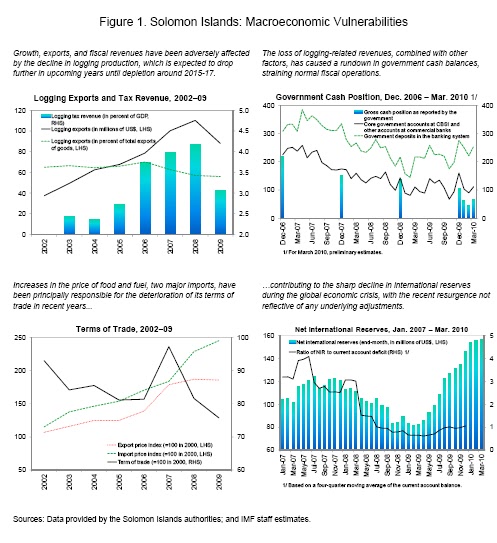
IMF Advice to Solomon Islands on Growth


Still the standard advice is more structural reforms;

The authorities’ acknowledge that further progress on the agenda of structural reform is needed to strengthen medium-term growth prospects. They intend to build on the steps taken to commercialize operations in stateowned enterprises; improve competitiveness, including the deregulation of telecommunications; and reduce the cost of doing business through revision of the legal framework.

In view of the adverse impact of the global economic downturn, the key objective of the authorities’ economic reform program is to establish a basis for resuming solid growth and reducing external vulnerability in a low-inflation environment, while advancing poverty alleviation efforts. To this end, the program seeks to strengthen the fiscal position, enhance monetary policy operations, and safeguard the domestic financial sector. By laying a strong macroeconomic foundation, the program is also expected to help catalyze additional donor support for the country.

Fiscal discipline will continue to serve as the main anchor for macroeconomic stability. Efforts will focus on rebuilding cash reserves mainly by strengthening revenue collection and prioritizing expenditure. Adopting a fiscal responsibility law and devising a proper resource tax regime would help enhance budget discipline, improve revenue transparency, and ensure a sustainable fiscal path.

“The current monetary stance is broadly appropriate, and sufficiently accommodative to support economic recovery. The program seeks to strengthen the operational framework of monetary policy and introduce new policy instruments to help banks manage liquidity, ensuring long-term price stability.

Binding Constraints for Growth in Solomon Islands

Interesting report on regenerating growth in Solomon Islands-

The report warns that examples of rapid and sustained economic growth globally are rare. The Pacific Island Countries face particular disadvantages, due to their small size and large distance to major markets. Solomon Islands may face especially severe constraints, as its scattered population reduces access to infrastructure and increases the costs of transport.

"Solomon Islands faces economic challenges, but growth prospects are reasonable if Solomon Islands plays to its existing advantages and capabilities," said Doug Porter, who led the study.

The report states that prospects for economic development in Solomon Islands will be significantly improved if four key potential sources of growth are prioritized. These areas include:

-Increasing productivity in agricultural production, on which most Solomon Islanders will continue to rely
-Ensuring that major natural resource industries - including mining and tourism – are well regulated, so that benefits flow to Solomon Islanders
-Increasing labor mobility, with Solomon Islanders having increased opportunities to acquire skills and incomes from work in Australian, New Zealand and other overseas economies.
-Improving the administration of aid, with more predictable flows of resources and capacity, with mutual accountability for results.
According to the report, economic growth is likely to be concentrated in urban centers, areas of high agricultural production, and areas with natural resource potential.

"However benefits can be shared throughout the country if efforts are made to connect rural populations to urban markets, and carefully target investment in services and infrastructure where economic activity and population are concentrated," said Doug Porter.

Related:
Solomon Islands Sources of Growth
Key Findings Summary

Wednesday, September 22, 2010

New Blogs on Development

Added a few new blog finds to the feeds;

Chandan Sapkota's blog;
I am interested in development economics, economic growth, and economic policy. Apart from blogging, I also write op-eds focusing on economic growth and public policy pertinent to the Nepali economy

Development Horizons from Lawrence Haddad

Economics, my dear Watson- recommended, reasonably good blog.

El Salavador's Eternal Binding Constraints

Perhaps the most telling indicator that El Salvador is not constrained by a lack of savings is that a dramatic boost in remittances has not been converted into investment. This suggests that the country invests little, not because it cannot mobilize resources (though savings are low) but because it cannot find productive investments.

IMF latest review of El Salvardor economy;

Over the longer term, further strengthening the economy’s growth prospects and reducing poverty, while safeguarding fiscal sustainability, requires a comprehensive strategy, including measures to raise revenues, structural reforms aimed at enhancing the business climate, and higher private investment...

The authorities’ strategy for 2011, which includes strengthening tax administration to increase revenues as well as reforming energy subsidies, will create space for high-priority social spending and public investment while lowering the fiscal deficit to 3.5 percent of GDP.

“Beyond 2011, timely enactment of a fiscal pact, which includes measures to raise revenue on a durable basis, and continued adherence to expenditure targets in the authorities’ program will be critical to sustain fiscal consolidation, placing the debt-to-GDP ratio on a firm downward path.

“Continued commitment to the dollarization regime has been the cornerstone of macroeconomic and financial stability. While the Salvadoran banking system is liquid and well-capitalized, it would benefit from further reforms aimed at enhancing its resilience. Approving the Financial Sector Supervision and Regulation Law, bolstering the corporate governance of banks, and upgrading the bank resolution framework will be key to this objective. Limiting the fiscal risks associated with the provision of credit by public banks will also be necessary,” Mr. Shinohara said.

Monday, September 20, 2010

Technologies Drive Growth, Rules Drive Development

A summary of comments by Paul Romer on development and growth at USAID conference-

Initially, he was first asked to speak about Aid Effectiveness but he wanted to talk about effective comparative to what. He thinks we should still be realistically ambitious and part of that is to look at best successes – China and development of US, including the expansion of the US frontier.

In his view, the key element regarding China’s development as well as the history of US lies in the concept of norms and rules. (He chooses not to use the words governance and institutions as they sometimes have certain connotations).

First, he outlined the difference between the sharing of ideas versus objects. Ideas are non rival compared to objects which are finite. Objects are finite - the more people around the fewer objects for each. However with ideas, the more people, the more ideas are developed. So the non rivalry of ideas and the power that comes from sharing amongst each other is inherent in successes of globalization, urbanization, and communication networks. The discovery and sharing of ideas helps countries that were behind, to catch up economically and developmentally.

He then linked ideas with the development of rules and used the example of Mauritius where a change of rules helped with rapid expansion of economic growth. If you can change rules, technology transfer can be done more quickly which supports economic growth. China has experienced that same dynamic – a change in rules led to special zones, foreign investment, increased expertise, a dramatic increase in manufacturing and rapid increase in economic growth and income. He posits that the puzzle of development needs to be framed around persistent stagnation – growth isn’t surprising, but stagnation is. Why do inefficient rules and ideas persist, limiting growth?

Then, he discussed formal versus informal rules, whereby formal rules are enforced through laws and informal ones are cultural, decentralized, and socially based. Informal laws are flexible and can lead to multiple equilibriums – what your norms are of right and wrong are based on what you see around you. All kinds of rules are enforced by informal norms. Norms can be functional at one point that become dysfunctional later – for example, norms regarding sharing versus norms of individual responsibility and work. But norms are very hard to change. So the answer to why rules can be so wildly inefficient for so long, although could sometimes change, has to do with the stability of norms.

Economists are much too ready to assume rules that are once and done – establish laws and then you’re done. But rules might need to change over time. Need new rules based on new technologies. Another driver of change is scale – rules and social norms that were designed for a small group of people and with scale you now need formal rules and then enforcement. So need to think about “metarules” – what are the rules for when you need to change the rules.

Norms are socially determined, as well as based on persuasion and the educational system. Efficient rules depend on the technologies, patterns of interaction, and distribution of norms in a population. Substitution between formal and informal rules depends on the norms that exist in different parts of the world – so formal rules aren’t always universal. Dynamics of informal rules and norms can trap groups making the shift to new rules and processes difficult. You see this in the business world where large corporations often can’t be as flexible as a startup – they are stuck with older norms that are harder to shift.

Executive action can change norms – i.e. the anticorruption commission created in Hong Kong, which was coupled by anticorruption campaign. It undermined corruption as an accepted norm. But how do you translate this to other contexts?

One way is to focus upon start ups and new norms. The notion of a start up is an important metarule – new initiatives have a chance to set up fresh and good norms. You can create a new set of norms among people who share your concepts, create a model and then acculturate the newer people to follow these standards, thus expanding the norms and rules outward.
This theory is behind his assertion that new Charter Cities can be an important development tool. Romer feels it would be possible to create hundreds of cities that are set up with new norms, special zones where new rules can be implemented, so you can recreate what happened in the US when it was developing and expanding its frontier. That situation, the new US cities attracted outsiders through opportunities and services. One can replicate this success by creating a competition of new cities, such as having hundreds of Dubais, where there would be competition for better living standards. The timing is ripe for this method as the world continues to urbanize currently – once the world’s population stabilizes and people stop moving into new cities, this start up concept will no longer be possible. So we need to look at meta rules beyond just voting, but start ups and other ways to affect norms which impact economic growth and development.

Listen to the discussion

Sunday, August 1, 2010

Lack of Self Discovery in Italy

An interesting piece on problems with Italian economy;

Study the numbers and you will find symptoms of distress that look a lot like those of Greece. Public sector debt amounts to roughly 118 percent of the gross domestic product, nearly identical to Greece. And like Greece, Italy is trying to ease fears in the euro zone and elsewhere with an austerity package, one intended to cut the deficit in half, to 2.7 percent of G.D.P., by 2012.

But dig a little deeper and the similarities end. The Italians, unlike the Greeks, are born savers, and much of the Italian debt is owned by the Italians. That means that unlike Greece, which will be sending a sizable percentage of its G.D.P. to foreign creditors for a generation to come, Italy is basically in hock to its own citizens.

“I know that in the States, all Mediterranean countries get lumped together,” says Carlo Altomonte, an economist with Bocconi University in Milan. “But Italy’s problem isn’t that we have a lot of debt. It’s that we don’t grow.” ...

But sales for Luciano Barbera clothing and Carlo Barbera fabric have drastically slowed in recent years. In the late ’90s, the mill enjoyed record annual sales of what amounts to about $15.5 million, Mr. Barbera says. Last year, the figure was half that sum.

WHEN describing the ills of his businesses, Mr. Barbera tends to focus on one issue: the “Made in Italy” label. For the last decade, he says, a growing number of clothing designers have been buying cheaper fabric in China, Bulgaria and elsewhere and slapping “Made in Italy” on garments, even if those garments are merely sewn here.

Until recently, there weren’t any rules about what “Made in Italy” actually meant, but that will change when a new law goes into effect in October. It states that if at least two stages of production — there are four stages altogether — occur in Italy, a garment is made in Italy....

To understand why his factory, and so much of Italy, is stagnant or worse, requires a bit of geopolitical history and a look at the highly idiosyncratic business culture here. It is defined, to a large degree, by deep-seated mistrust — not just of the government, but of anyone who isn’t part of the immediate family — as well as a widespread aversion to risk and to growth that to American eyes looks almost quaint...

FIVE years ago, Francesco Giavazzi needed a taxi. Cabs are relatively scarce in Milan, especially at 5 a.m., when he wanted to head to the airport, so he called a company at 4:30 to schedule a pickup. But when he climbed into the cab half an hour later, he discovered that the meter had been running for more than 20 minutes, because the taxi driver had arrived soon after the call and started charging for his time. Allowed by the rules, but to Mr. Giavazzi, utterly unfair.

“So it was 20 euros before we started the trip to the airport,” recalls Mr. Giavazzi, who is an economics professor at Bocconi University. “I said, ‘This is impossible.’ ”

Professor Giavazzi later wrote an op-ed article denouncing this episode as another example of the toll exacted by Italy’s innumerable guilds, known by several names here, including “associazioni di categoria.” (These are different from unions, another force here, in that guilds are made up of independent players in a trade or profession who have joined to keep outsiders out and maintain standards, as opposed to representing employees in negotiations with management, as a union might.) Even baby sitters have associations in Italy.

The op-ed did not endear Professor Giavazzi to the city’s cab drivers. They pinned leaflets with his name and address at taxi stands around Milan and for the next five nights, cabs drove around his home, honking their horns.

“This is a country with a lot of rents,” says Professor Giavazzi, sitting in his office one recent afternoon, using the economists’ term for excess profits that flow to a business because of a lack of competition. “You need a notary public, it’s like 1,000 euros before you even open your mouth. If you’re a notary public in this country, you live like a king.”...

Roughly one-quarter of Italy’s G.D.P. is off the books. When you inquire about the cause and persistence of this longstanding fact of life, people here say that most Italians have little sense of national identity, an obstacle to a system of national taxation. The country didn’t really begin to transcend its clannish roots and regional dialects until after World War II; even today, displays of national pride are reserved for World Cup victories and little else.

Italians, notes Professor Altomonte, are among the world’s heaviest consumers of bottled water. “Do you know why? Because the water in the tap comes from the government.”...

The suspicion of Italians when it comes to extra-familial institutions explains why many here care more about protecting what they have than enhancing their wealth. Most Italians live less than a mile or two from their parents and stay there, often for financial benefits like cash and in-kind services like day care. It’s an insularity that runs all the way up to the corporate suites. The first goal of many entrepreneurs here isn’t growth, so much as keeping the business in the family. For a company to really expand, it needs capital, but that means giving up at least some control. So thousands of companies here remain stubbornly small — all of which means Italy is a haven for artisans but is in a lousy position to play the global domination game...

To Professor Giavazzi, the future here doesn’t look like Greece. It looks like Argentina.

“Before World War II, Argentina was rich,” he says. “Even in 1960, the country was twice as rich as Italy.” Today, he says, you can compare the per capita income of Argentina to that of Romania. “Because it didn’t grow. A country could get rich in 1900 just by producing corn and meat, but that is not true today. But it took them 100 years to realize they were becoming poor. And that is what worries me about Italy. We’re not going to starve next week. We are just going to decline, slowly, slowly, and I’m not sure what will turn that around.”
-Is Italy Too Italian?

Friday, May 21, 2010

What are binding constraints to growth in Fiji?

Is land reform the most binding constraint to growth in Fiji?

A comprehensive package of structural reforms is being prepared by the authorities to spur growth and create jobs. This includes reforms to the civil service, public enterprises, public pension fund, and land-lease system—together with price liberalization. Staff noted the importance of well designed reforms to lift potential growth...

Land tenure reform is a key priority of the Government’s reform agenda. It is also an area that Staff and other multilateral institutions also consider as vital to raising the economic growth potential of the economy given large areas of unutilized arable land. The Government has formed a task force that will facilitate utilization of idle land for productive use. Land will be available for leases under this effort from the first quarter of 2010.


For Discussion: What do you think are the binding constraints to growth in Fiji?


Related:
Fisheries in the Economies of the Pacific Island Countries and Territories

Finding Balance-Making State-Owned Enterprises Work in Fiji, Samoa, and Tonga

IMF loan for Fiji seen as long-term liability

Doing Business - Fiji

WDI -Fiji

Binding Constraints in the Pacific

Wednesday, May 19, 2010

Sri Lanka - Quick and Dirty Growth Diagnostic?


From a recent economic update of Sri Lanka (World Bank);
Raising the long-term growth rate in Sri Lanka to 8 percent would require a comprehensive policy agenda. The government has committed itself to raising the long-term growth rate of the Sri Lankan economy. A standard growth-accounting framework illustrates how this can be achieved. Within this framework, growth can increase by any combination of: (i) accelerated human capital accumulation, either through increase labor force participation and employment or improvements in the quality of labor (more or better schooling); (ii) accelerated physical capital-accumulation through higher investments, or (iii) higher “total-factor-productivity” (TFP), which is the catch-all residual for structural improvements affecting the efficiency of use of human and physical capital. TFP improvements can happen in many ways (e.g., as a result of efficiency gains at the level of the individual business or factory or, e.g., as a result of sectoral shifts in the economy, from lower- to higher-productivity sectors, such as from agriculture to industry or services).

The scenario takes as starting point that growth will gradually accelerate to 8 percent by 2013—broadly in line with the Government’s medium term targets. It then asks, what are the requirements to the three underlying drivers of growth to achieve this target? It is clear that all factors—the input of labor, the level of investments, and the rate of overall productivity growth—would have to increase well beyond the levels of the past year. Specifically, the labor-force participation rate would have to gradually increase from its current level of around 49 percent, to 52-53 percent—equivalent to 500,000 jobs created in the next decade, over and above the number of jobs necessary to absorb the underlying population growth. In terms of capital accumulation, an increase in the ratio of investments-to-GDP from the current level of about 25 percent, to around 30 percent, would be required. Some of this increase may be financed by foreign direct investment (FDI), but it would also probably require an increase in national savings. Finally, TFP would have to increase to around 3 percent per annum—about 1 percentage point higher than its average level during the recent high-growth period from 2004-08, and well above its historical average since 1980


Related:
PREM Note 42: Measuring growth in total factor productivity

What use is sources-of-growth accounting?;
So here is a contest for economist (or wannabe economist) readers of this blog: can you come up with an interesting question to which a sources-of-growth decomposition is the answer?

Saturday, May 1, 2010

Thoughts for your reflection- Cities and Economic Growth

All throughout history, we’ve thought of heaven as the city on a hill. Done right, a city can be the pinnacle of human civilization. They’re the cathedrals of our era,”- Paul Romer

Related:
Global Prosperity Wonkcast;
“…just because something is unfamiliar that doesn’t mean it’s inconceivable or it can’t happen…[T]hink more broadly [about] challenges that look intractable — poverty, the environment, green globalization, an urbanization wave of 3 billion people. If we open up our notion of what’s possible then these intractable problems look like real opportunities that could reshape the globe and change history.”


Romer on Charter Cities


Paul Romer’s Bold New Idea for Charter Cities

Why Humanity Loves, and Needs, Cities;
The figure shows the 25 percent correlation between the logarithms of population density and 2008 gross metropolitan product per capita (using 2000 Census population numbers). Per capita productivity increases by 4 percent as population density rises by 50 percent.
But why does productivity rise with density?


A Tale of Many Cities

Cities Do It Better