Like many Americans, I looked to Barack Obama as the hope for a breakthrough. Change was on the way, or so we hoped; yet there has been far more continuity than change. Obama has continued down the well-trodden path of open-ended war in Afghanistan, massive military budgets, kowtowing to lobbyists, stingy foreign aid, unaffordable tax cuts, unprecedented budget deficits, and a disquieting unwillingness to address the deeper causes of America’s problems. The administration is packed with individuals passing through the revolving door that connects Wall Street and the White House.-Sachs, Jeffrey D. (2011-10-04). The Price of Civilization: Reawakening American Virtue and Prosperity (Kindle Locations 62-66). Random House. Kindle Edition.
Showing posts with label Books. Show all posts
Showing posts with label Books. Show all posts
Monday, December 5, 2011
The Price of Civilization


Friday, December 2, 2011
Why IMF did nothing when Russia defaulted
We hear relatively little about the struggles between “area” departments, which tend to be relatively sympathetic to the countries they oversee, and “functional” departments such as those responsible for monetary and fiscal policies, which tend to be more critical. Certain departments within the IMF are notorious for being more or less open to new ideas; one functional department during the period in question was informally referred to, less than fondly, as the thought police. Again, this is something about which one would wish to learn more....
The book turns next to the Mexican, Russian, and Asian crises. Although these episodes have been extensively analyzed, Boughton offers a few revelations. We are told, for example, how the IMF first learned of the peso’s impending devaluation not from the Mexican government but through an offhand remark by a high-ranking U.S. official. We learn that the reason the IMF did not do more to discourage Russia from defaulting was because of a telephonic miscommunication between Camdessus, on summer vacation in Bayonne, France, and the Fund’s man in Moscow, John Odling-Smee.
At points the drama is compelling. One cannot help but be impressed by the number of emergency phone calls at 2:00 a.m., and by how frantically IMF officials shuttled to Moscow and Jakarta to keep the world economy from falling off a cliff.
Boughton describes just how close the world came in 1995, in 1997, and again in 1998 to a “Lehman Brothers moment.” In retrospect it is clear that, already in the 1990s, something was dreadfully wrong with a global financial system that was so vulnerable to collapse. One wonders why the IMF did not do more at the time to rectify the problem.
Sunday, November 20, 2011
Thinking Fast and Slow
In the highly anticipated Thinking, Fast and Slow, Kahneman takes us on a groundbreaking tour of the mind and explains the two systems that drive the way we think. System 1 is fast, intuitive, and emotional; System 2 is slower, more deliberative, and more logical. Kahneman exposes the extraordinary capabilities—and also the faults and biases—of fast thinking, and reveals the pervasive influence of intuitive impressions on our thoughts and behavior. The impact of loss aversion and overconfidence on corporate strategies, the difficulties of predicting what will make us happy in the future, the challenges of properly framing risks at work and at home, the profound effect of cognitive biases on everything from playing the stock market to planning the next vacation—each of these can be understood only by knowing how the two systems work together to shape our judgments and decisions.
Wednesday, November 9, 2011
Book Recommendation
'In Capitalist Revolutionary, Backhouse and Bateman cut through the misinformation, the caricature, and maybe even the web memes, to give us an actually useful understanding of Keynes as a philosopher offering a moral critique of our capitalist system.
According to Backhouse and Bateman, Keynes was essentially a man who wanted to create a revolution in how we thought about economic problems'Peter Boettke highly recommends the book- 'the most informative and best read on Keynes that I have read recently'
The Economics of Good and Evil
Economics of Good and Evil-The Quest for Economic Meaning from Gilgamesh to Wall StreetTomas Sedlacek
Think the quality of writing needs much improvement.
There’s a song that says that rules and laws are created by lawyers and poets. Poets (in the wider meaning of the term) give rules meaning and spirit; lawyers give them form and letter. Similarly, we may say that a great economist can be either an outstanding mathematician or an excellent philosopher. It appears to me that we have given lawyers and mathematicians too large a role at the expense of poets and philosophers. We have exchanged too much wisdom for exactness, too much humanity for mathematization.-Sedlacek, Tomas; Havel, Vaclav; Havel, Václav (2011-06-03). Economics of Good and Evil : The Quest for Economic Meaning from Gilgamesh to Wall Street (Kindle Locations 5420-5422). Oxford University Press, USA. Kindle Edition.
Think the quality of writing needs much improvement.
Friday, October 7, 2011
Elizabeth Warren talk
The previous fall, Geithner huddled with top aides to develop what one called an “Elizabeth Warren strategy,” a plan to engage with the firebrand reformer that would render her politically inert. He never worked out a viable strategy—a way to meet with Warren without drawing undesirable comparisons—and so, like the president, he didn’t.-Suskind, Ron (2011-09-20). Confidence Men: Wall Street, Washington, and the Education of a President (pp. 4-5). Harper. Kindle Edition. Related: Consumer Finance Protection Bureau
Monday, September 26, 2011
Confidence Men
Brad de Long reviews Confidence Men;
Since the spring of 2009 I have became more and more alarmed by the economic policy choices made by the Obama administration. A new administration needs to (1) forecast what is most likely to happen, and (2) design and implement policies that will deal with what is likely to happen, The Obama administration did that. I think that some of its initial policies were wrong, but given the press of events I would give the administration moderately high marks for the policies it designed and implemented up through, say, April 2009.
Thereafter, however, things to me seemed to gradually fall apart. An administration has a third task it needs to carry out: (3) think hard about the risks--what if the administration has misjudged the situation? what if more things go wrong?--figure out what it needs to do to buy insurance against those risks, and do those things as well.
It needs to ask itself:
Why Obama chose the policies he did, why Geithner and Orszag and company were so optimistic in 2009, why the Reconciliation process was not teed up for emergency expansionary fiscal policy action if it turned out to be necessary, why Fannie and Freddie were not teed up for emergency mortgage action if it turned out to be necessary, why the administration turned so decisively away from unemployment and toward long-term deficit reduction in early 2010, why Summers and Romer did not wipe the floor with Geithner and Orszag in the long twilight bureaucratic struggle when NEC collegiality broke down, and why Bernanke forgot about the employment and output part of the Federal Reserve's dual mandate - these are all questions that I would dearly love to know the answers to.
- What if we are wrong in our estimation of the situation--what might the world then look like three years from now?
- What if more things go wrong in the next year or two--what might the world then look like three years from now?
- In those possible scenarios, what will we wish then that we had done today to prepare the way for dealing with the situation?
....
Two and a half years ago I would have given long odds that Ron Suskind's book would provide me with a lot of the answers to these questions.
It does not.
Friday, August 5, 2011
Thursday, August 4, 2011

Tuesday, July 26, 2011

Friday, April 22, 2011
Free Read on Behavioral Public Economics

William J. Congdon, Jeffrey R. Kling and Sendhil Mullainathan, Brookings Institution Press
Saturday, December 4, 2010

Book Recommendation

Constitutional Reform, Liberalism, and the Rise of Western Democracy
Roger D. Congleton, George Mason University
Tuesday, November 30, 2010


Thursday, November 25, 2010
Book Recommendations
Books that have influenced the Austrian Economist;
“Notes on Democracy” By H L Mencken: Wonderfully written. I have never enjoyed anything in the recent past than Mencken’s elitist views. I wonder why I never read him before. He has a deep contempt for the unthinking masses, which I happen to share. He writes, (on the common man): “A politician by instinct and a statesman by divine right, he has never heard of “The Republic” or “Leviathan.” A Feinschmecker of pornography, he is unaware of Freud.”
“How to Develop a Super Power Memory” by Harry Lorayne: I read it when I was 17 and just out of school. I owe my near-photographic memory to this book, among many others. It helped me realize that our mind has several powers which we don’t even know of.
“Notes on Democracy” By H L Mencken: Wonderfully written. I have never enjoyed anything in the recent past than Mencken’s elitist views. I wonder why I never read him before. He has a deep contempt for the unthinking masses, which I happen to share. He writes, (on the common man): “A politician by instinct and a statesman by divine right, he has never heard of “The Republic” or “Leviathan.” A Feinschmecker of pornography, he is unaware of Freud.”
“How to Develop a Super Power Memory” by Harry Lorayne: I read it when I was 17 and just out of school. I owe my near-photographic memory to this book, among many others. It helped me realize that our mind has several powers which we don’t even know of.
Friday, November 12, 2010
Book Recommendation- Growth and Natural Resource exploitation

Edward B. Barbier, University of Wyoming
Throughout much of history, a critical driving force behind global economic development has been the response of society to the scarcity of key natural resources. Increasing scarcity raises the cost of exploiting existing natural resources and creates incentives in all economies to innovate and conserve more of these resources. However, economies have also responded to increasing scarcity by obtaining and developing more of these resources. Since the agricultural transition over 12,000 years ago, this exploitation of new 'frontiers' has often proved to be a pivotal human response to natural resource scarcity. This book provides a fascinating account of the contribution that natural resource exploitation has made to economic development in key eras of world history. This not only fills an important gap in the literature on economic history but also shows how we can draw lessons from these past epochs for attaining sustainable economic development in the world today.
Friday, September 3, 2010
Mankiw and Arnold's Freshmen Seminar
Mankiw's list;
Arnold Kling's list;
1. Jerry Muller, The Mind and the Market.
2. Robert Frank The Economic Naturalist.
3. Carl Shapiro and Hal Varian, Information Rules.
4. Matt Ridley, The Rational Optimist.
5. Kevin Lang, Poverty and Discrimination.
6. Ed Leamer, Macroeconomic Patterns and Stories.
7. Burton Malkiel, A Random Walk Down Wall Street.
8. Tyler Cowen, The Age of the Infovore.
The Worldly Philosophers, by Robert Heilbronr
Reinventing the Bazaar: A Natural History of Markets, by John McMillan
Thinking Strategically, by Avinash Dixit and Barry Nalebuff
Capitalism and Freedom, by Milton Friedman
Equality and Efficiency: The Big Tradeoff, by Arthur Okun
Nudge, by Richard Thaler and Cass Sunstein
How the Economy Works, by Roger E.A. Farmer
The Return of Depression Economics, by Paul Krugman
The Road to Serfdom, Friedrich Hayek
The Myth of the Rational Voter, by Bryan Caplan
The Big Questions, by Steven Landsburg
Arnold Kling's list;
1. Jerry Muller, The Mind and the Market.
2. Robert Frank The Economic Naturalist.
3. Carl Shapiro and Hal Varian, Information Rules.
4. Matt Ridley, The Rational Optimist.
5. Kevin Lang, Poverty and Discrimination.
6. Ed Leamer, Macroeconomic Patterns and Stories.
7. Burton Malkiel, A Random Walk Down Wall Street.
8. Tyler Cowen, The Age of the Infovore.
Thursday, September 2, 2010
Tuesday, August 31, 2010
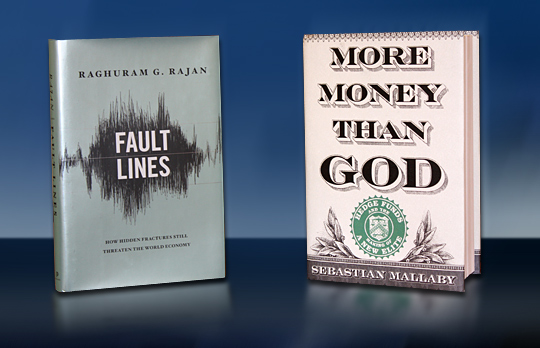
Two Book Recommendations
Related:
Predicting the Financial Crisis: A Q&A With Fault Lines Author Raghuram Rajan
Subscribe to:
Posts (Atom)


.png)