Wednesday, September 22, 2010

El Salavador's Eternal Binding Constraints

Perhaps the most telling indicator that El Salvador is not constrained by a lack of savings is that a dramatic boost in remittances has not been converted into investment. This suggests that the country invests little, not because it cannot mobilize resources (though savings are low) but because it cannot find productive investments.
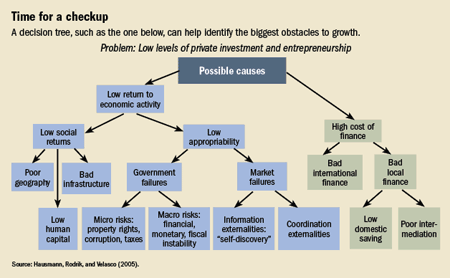
IMF latest review of El Salvardor economy;

Over the longer term, further strengthening the economy’s growth prospects and reducing poverty, while safeguarding fiscal sustainability, requires a comprehensive strategy, including measures to raise revenues, structural reforms aimed at enhancing the business climate, and higher private investment...

The authorities’ strategy for 2011, which includes strengthening tax administration to increase revenues as well as reforming energy subsidies, will create space for high-priority social spending and public investment while lowering the fiscal deficit to 3.5 percent of GDP.

“Beyond 2011, timely enactment of a fiscal pact, which includes measures to raise revenue on a durable basis, and continued adherence to expenditure targets in the authorities’ program will be critical to sustain fiscal consolidation, placing the debt-to-GDP ratio on a firm downward path.

“Continued commitment to the dollarization regime has been the cornerstone of macroeconomic and financial stability. While the Salvadoran banking system is liquid and well-capitalized, it would benefit from further reforms aimed at enhancing its resilience. Approving the Financial Sector Supervision and Regulation Law, bolstering the corporate governance of banks, and upgrading the bank resolution framework will be key to this objective. Limiting the fiscal risks associated with the provision of credit by public banks will also be necessary,” Mr. Shinohara said.

Tuesday, September 21, 2010

Quote on Unemployment

We cannot admit that unemployment is a natural consequence of the ideal that economists revere as 'higher productivity' -Alain de Botton

Related Podcast;
de Botton on the Pleasures and Sorrows of Work
At one point in book lovely parallel between an Edward Hopper painting and a woman at work writing a marketing study. Hopper really tried to force the eye to notice a lot of that--the industrial life, the unseen, quiet moments of daily existence, not cathedrals or great landmarks. Lots of pictures of paintings of corners of things. Help us see some of the things we are looking at. Hopper classic example. Can't be an American today in many situations without that word "Hopperesque" coming to mind. Be it the late-night motel, the bar, the diner, whatever, we'll be in the footsteps of this great painter. Art is putting post-it notes on parts of the world going, Notice this. Your book is a tourist guide to some of the aspects of modern work.

Monday, September 20, 2010

Technologies Drive Growth, Rules Drive Development

A summary of comments by Paul Romer on development and growth at USAID conference-

Initially, he was first asked to speak about Aid Effectiveness but he wanted to talk about effective comparative to what. He thinks we should still be realistically ambitious and part of that is to look at best successes – China and development of US, including the expansion of the US frontier.

In his view, the key element regarding China’s development as well as the history of US lies in the concept of norms and rules. (He chooses not to use the words governance and institutions as they sometimes have certain connotations).

First, he outlined the difference between the sharing of ideas versus objects. Ideas are non rival compared to objects which are finite. Objects are finite - the more people around the fewer objects for each. However with ideas, the more people, the more ideas are developed. So the non rivalry of ideas and the power that comes from sharing amongst each other is inherent in successes of globalization, urbanization, and communication networks. The discovery and sharing of ideas helps countries that were behind, to catch up economically and developmentally.

He then linked ideas with the development of rules and used the example of Mauritius where a change of rules helped with rapid expansion of economic growth. If you can change rules, technology transfer can be done more quickly which supports economic growth. China has experienced that same dynamic – a change in rules led to special zones, foreign investment, increased expertise, a dramatic increase in manufacturing and rapid increase in economic growth and income. He posits that the puzzle of development needs to be framed around persistent stagnation – growth isn’t surprising, but stagnation is. Why do inefficient rules and ideas persist, limiting growth?

Then, he discussed formal versus informal rules, whereby formal rules are enforced through laws and informal ones are cultural, decentralized, and socially based. Informal laws are flexible and can lead to multiple equilibriums – what your norms are of right and wrong are based on what you see around you. All kinds of rules are enforced by informal norms. Norms can be functional at one point that become dysfunctional later – for example, norms regarding sharing versus norms of individual responsibility and work. But norms are very hard to change. So the answer to why rules can be so wildly inefficient for so long, although could sometimes change, has to do with the stability of norms.

Economists are much too ready to assume rules that are once and done – establish laws and then you’re done. But rules might need to change over time. Need new rules based on new technologies. Another driver of change is scale – rules and social norms that were designed for a small group of people and with scale you now need formal rules and then enforcement. So need to think about “metarules” – what are the rules for when you need to change the rules.

Norms are socially determined, as well as based on persuasion and the educational system. Efficient rules depend on the technologies, patterns of interaction, and distribution of norms in a population. Substitution between formal and informal rules depends on the norms that exist in different parts of the world – so formal rules aren’t always universal. Dynamics of informal rules and norms can trap groups making the shift to new rules and processes difficult. You see this in the business world where large corporations often can’t be as flexible as a startup – they are stuck with older norms that are harder to shift.

Executive action can change norms – i.e. the anticorruption commission created in Hong Kong, which was coupled by anticorruption campaign. It undermined corruption as an accepted norm. But how do you translate this to other contexts?

One way is to focus upon start ups and new norms. The notion of a start up is an important metarule – new initiatives have a chance to set up fresh and good norms. You can create a new set of norms among people who share your concepts, create a model and then acculturate the newer people to follow these standards, thus expanding the norms and rules outward.
This theory is behind his assertion that new Charter Cities can be an important development tool. Romer feels it would be possible to create hundreds of cities that are set up with new norms, special zones where new rules can be implemented, so you can recreate what happened in the US when it was developing and expanding its frontier. That situation, the new US cities attracted outsiders through opportunities and services. One can replicate this success by creating a competition of new cities, such as having hundreds of Dubais, where there would be competition for better living standards. The timing is ripe for this method as the world continues to urbanize currently – once the world’s population stabilizes and people stop moving into new cities, this start up concept will no longer be possible. So we need to look at meta rules beyond just voting, but start ups and other ways to affect norms which impact economic growth and development.

Listen to the discussion

Friday, September 17, 2010

Cyprus Economy Watch

IMF releases Article IV review of Cyprus;
Background. Economic conditions have stabilized, and the economy is projected to bottom out in 2010, giving way to a mild recovery in 2011 followed by stronger growth. However, global financial risks remain elevated and muted growth prospects in trading partners weigh on the outlook. The government has taken steps to stabilize the fiscal deficit, but further measures will be needed to reach the official deficit target for 2012 of 3 percent of GDP.

Challenges and staff views. The foremost policy challenge is to achieve the official fiscal consolidation targets so as to put debt ratios on a declining path and provide more space to guard against risks to the financial sector. Further old-age pension reform is also essential. Preserving financial sector stability through early detection of risks remains a top priority in light of the difficult economic and financial environment, and the supervision of cooperative credit societies needs to be strengthened as a matter of urgency. Structural reforms are needed to preserve competitiveness and enhance medium-term growth.

Authorities’ views. The government largely shared the staff’s assessment, while projecting growth to turn positive as soon as 2010 and being more confident that the fiscal targets can be met through general spending restraint and with less focus on the public payroll. The Central Bank of Cyprus (CBC) expressed confidence in the ability of banks to withstand pressures, and this is supported by stress test results. Moving to a single independent supervisor for all credit institutions—a much desirable objective—is not on the political
agenda, but strengthening the supervision of cooperative credit societies seems feasible.

Friday, September 3, 2010

Statistical Literacy for MPs

Statistics Briefs from UK Parliament

Mankiw and Arnold's Freshmen Seminar

Mankiw's list;

The Worldly Philosophers, by Robert Heilbronr
Reinventing the Bazaar: A Natural History of Markets, by John McMillan
Thinking Strategically, by Avinash Dixit and Barry Nalebuff
Capitalism and Freedom, by Milton Friedman
Equality and Efficiency: The Big Tradeoff, by Arthur Okun
Nudge, by Richard Thaler and Cass Sunstein
How the Economy Works, by Roger E.A. Farmer
The Return of Depression Economics, by Paul Krugman
The Road to Serfdom, Friedrich Hayek
The Myth of the Rational Voter, by Bryan Caplan
The Big Questions, by Steven Landsburg

Arnold Kling's list;
1. Jerry Muller, The Mind and the Market.
2. Robert Frank The Economic Naturalist.
3. Carl Shapiro and Hal Varian, Information Rules.
4. Matt Ridley, The Rational Optimist.
5. Kevin Lang, Poverty and Discrimination.
6. Ed Leamer, Macroeconomic Patterns and Stories.
7. Burton Malkiel, A Random Walk Down Wall Street.
8. Tyler Cowen, The Age of the Infovore.


Thursday, September 2, 2010

Another book on applied economic policy

Uganda's Economic Reforms -Insider Accounts

A Must Read Book

Picturing the Uncertain World: How to Understand, Communicate, and Control Uncertainty through Graphical Display
Howard Wainer

Related:
According to Diane Coyle;
This marvellous book by Howard Wainer, Picturing the Uncertain World: How to Understand, Communicate and Control Uncertainty through Graphical Display, is an absolute must for anyone who claims to be involved in the search for empirical evidence. It's a sequel to the same author's Graphic Discovery and also in the tradition of Edward Tufte's The Visual Display of Quantitative Information. All applied economists should have read carefully all three books and keep them close by for reference. So should all other researchers - social science, medicine, education - anybody who needs to navigate the shoals of carrying out robust empirical work and communicating it to others.

Picturing the Uncertain World : Summary
;
Three principles of effective display are mentioned that can be called “THREE COMMANDMENTS of effective data display of data”

1. Remind us that the data being displayed do contain some uncertainty , and then
2. Characterize the size of that uncertainty as as it pertains to the inferences we have in mind , and in so doing
3. help keep us from drawing incorrect conclusions through the lack of a full appreciation of the precision of our knowledge.

Tuesday, August 31, 2010

Tuesday, August 10, 2010

Assorted

RBI on India and the Global Financial Crisis
The Report on Currency and Finance 2008-09 published by the Reserve Bank of India this month is on the “Global Financial Crisis and the Global Economy.” Well over two-thirds of this 380 page report is about the global crisis itself and does not contain anything new. But about a hundred pages are devoted to the impact of the global crisis on India and to the policy responses in India.

"The High Price of Motherhood"

What Social Science Does—and Doesn’t—Know

Notes from the Field: Comparing Three Villages in Madhya Pradesh

When Labor Is Capital: The Limits of Keynesian Policy

Sunday, August 1, 2010

Lack of Self Discovery in Italy

An interesting piece on problems with Italian economy;

Study the numbers and you will find symptoms of distress that look a lot like those of Greece. Public sector debt amounts to roughly 118 percent of the gross domestic product, nearly identical to Greece. And like Greece, Italy is trying to ease fears in the euro zone and elsewhere with an austerity package, one intended to cut the deficit in half, to 2.7 percent of G.D.P., by 2012.

But dig a little deeper and the similarities end. The Italians, unlike the Greeks, are born savers, and much of the Italian debt is owned by the Italians. That means that unlike Greece, which will be sending a sizable percentage of its G.D.P. to foreign creditors for a generation to come, Italy is basically in hock to its own citizens.

“I know that in the States, all Mediterranean countries get lumped together,” says Carlo Altomonte, an economist with Bocconi University in Milan. “But Italy’s problem isn’t that we have a lot of debt. It’s that we don’t grow.” ...

But sales for Luciano Barbera clothing and Carlo Barbera fabric have drastically slowed in recent years. In the late ’90s, the mill enjoyed record annual sales of what amounts to about $15.5 million, Mr. Barbera says. Last year, the figure was half that sum.

WHEN describing the ills of his businesses, Mr. Barbera tends to focus on one issue: the “Made in Italy” label. For the last decade, he says, a growing number of clothing designers have been buying cheaper fabric in China, Bulgaria and elsewhere and slapping “Made in Italy” on garments, even if those garments are merely sewn here.

Until recently, there weren’t any rules about what “Made in Italy” actually meant, but that will change when a new law goes into effect in October. It states that if at least two stages of production — there are four stages altogether — occur in Italy, a garment is made in Italy....

To understand why his factory, and so much of Italy, is stagnant or worse, requires a bit of geopolitical history and a look at the highly idiosyncratic business culture here. It is defined, to a large degree, by deep-seated mistrust — not just of the government, but of anyone who isn’t part of the immediate family — as well as a widespread aversion to risk and to growth that to American eyes looks almost quaint...

FIVE years ago, Francesco Giavazzi needed a taxi. Cabs are relatively scarce in Milan, especially at 5 a.m., when he wanted to head to the airport, so he called a company at 4:30 to schedule a pickup. But when he climbed into the cab half an hour later, he discovered that the meter had been running for more than 20 minutes, because the taxi driver had arrived soon after the call and started charging for his time. Allowed by the rules, but to Mr. Giavazzi, utterly unfair.

“So it was 20 euros before we started the trip to the airport,” recalls Mr. Giavazzi, who is an economics professor at Bocconi University. “I said, ‘This is impossible.’ ”

Professor Giavazzi later wrote an op-ed article denouncing this episode as another example of the toll exacted by Italy’s innumerable guilds, known by several names here, including “associazioni di categoria.” (These are different from unions, another force here, in that guilds are made up of independent players in a trade or profession who have joined to keep outsiders out and maintain standards, as opposed to representing employees in negotiations with management, as a union might.) Even baby sitters have associations in Italy.

The op-ed did not endear Professor Giavazzi to the city’s cab drivers. They pinned leaflets with his name and address at taxi stands around Milan and for the next five nights, cabs drove around his home, honking their horns.

“This is a country with a lot of rents,” says Professor Giavazzi, sitting in his office one recent afternoon, using the economists’ term for excess profits that flow to a business because of a lack of competition. “You need a notary public, it’s like 1,000 euros before you even open your mouth. If you’re a notary public in this country, you live like a king.”...

Roughly one-quarter of Italy’s G.D.P. is off the books. When you inquire about the cause and persistence of this longstanding fact of life, people here say that most Italians have little sense of national identity, an obstacle to a system of national taxation. The country didn’t really begin to transcend its clannish roots and regional dialects until after World War II; even today, displays of national pride are reserved for World Cup victories and little else.

Italians, notes Professor Altomonte, are among the world’s heaviest consumers of bottled water. “Do you know why? Because the water in the tap comes from the government.”...

The suspicion of Italians when it comes to extra-familial institutions explains why many here care more about protecting what they have than enhancing their wealth. Most Italians live less than a mile or two from their parents and stay there, often for financial benefits like cash and in-kind services like day care. It’s an insularity that runs all the way up to the corporate suites. The first goal of many entrepreneurs here isn’t growth, so much as keeping the business in the family. For a company to really expand, it needs capital, but that means giving up at least some control. So thousands of companies here remain stubbornly small — all of which means Italy is a haven for artisans but is in a lousy position to play the global domination game...

To Professor Giavazzi, the future here doesn’t look like Greece. It looks like Argentina.

“Before World War II, Argentina was rich,” he says. “Even in 1960, the country was twice as rich as Italy.” Today, he says, you can compare the per capita income of Argentina to that of Romania. “Because it didn’t grow. A country could get rich in 1900 just by producing corn and meat, but that is not true today. But it took them 100 years to realize they were becoming poor. And that is what worries me about Italy. We’re not going to starve next week. We are just going to decline, slowly, slowly, and I’m not sure what will turn that around.”
-Is Italy Too Italian?

Friday, July 23, 2010

Origin of 'Dynamic Programming'

An interesting question is, ‘Where did the name, dynamic programming, come from?’ The 1950s were not good years for mathematical research. We had a very interesting gentleman in Washington named Wilson. He was Secretary of Defense, and he actually had a pathological fear and hatred of the word, research. I’m not using the term lightly; I’m using it precisely. His face would suffuse, he would turn red, and he would get violent if people used the term, research, in his presence. You can imagine how he felt, then, about the term, mathematical. The RAND Corporation was employed by the Air Force, and the Air Force had Wilson as its boss, essentially. Hence, I felt I had to do something to shield Wilson and the Air Force from the fact that I was really doing mathematics inside the RAND Corporation. What title, what name, could I choose? In the first place I was interested in planning, in decision making, in thinking. But planning, is not a good word for various reasons. I decided therefore to use the word, ‘programming.’ I wanted to get across the idea that this was dynamic, this was multistage, this was time-varying—I thought, let’s kill two birds with one stone. Let’s take a word that has an absolutely precise meaning, namely dynamic, in the classical physical sense. It also has a very interesting property as an adjective, and that is it’s impossible to use the word, dynamic, in a pejorative sense. Try thinking of some combination that will possibly give it a pejorative meaning. It’s impossible. Thus, I thought dynamic programming was a good name. It was something not even a Congressman could object to. So I used it as an umbrella for my activities (p. 159).

via Core Economics
Related;
Hamilton-Jacobi-Bellman Equation

Tuesday, July 13, 2010

Visualization of the Day

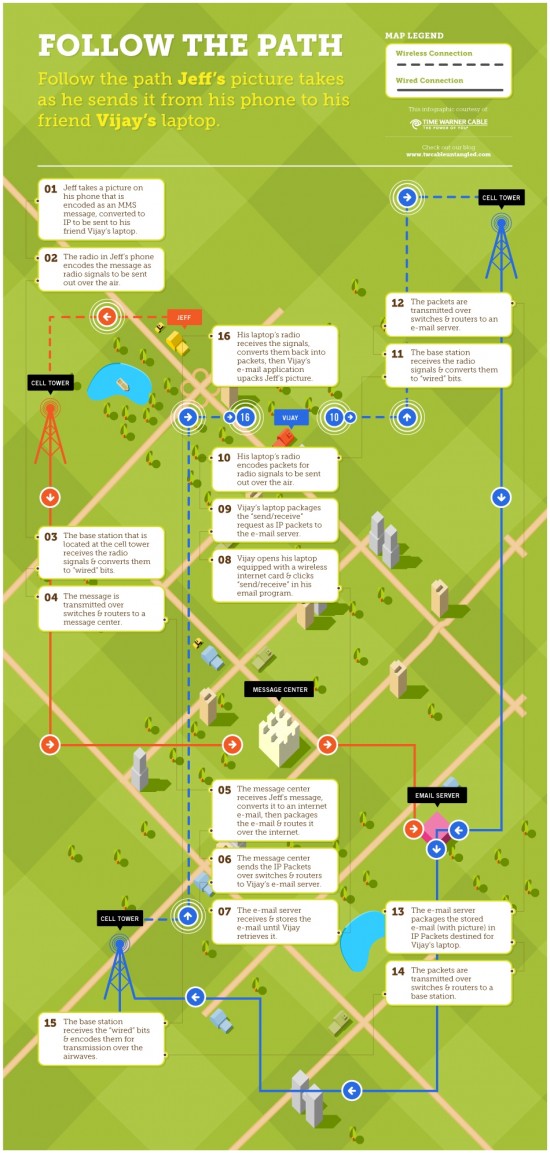
How data travels from phone to computer

Albania - V Shaped Recovery ahead


IMF Article IV Staff Report on Albania is released;

Outlook: The baseline is for a V-shaped recovery, albeit to a lower potential growth than before the crisis, with low inflation and external imbalances narrowing. However, downside risks are significant
and elevated budget financing requirements under unchanged policies will crowd out private investment,thereby undermining potential growth over the medium term.

Policy Discussions: A tighter fiscal stance with improvements in productivity and competitiveness is a superior adjustment strategy, and consolidation could serve to enhance, rather than damage, growth
prospects. The authorities’ fiscal adjustment strategy is based on over-optimistic revenue and growth expectations. There was agreement of the benefits of a clear, credible, and monitorable fiscal rule to safeguard fiscal sustainability. Monetary policy should remain cautious and supervisors remain vigilant, given heightened regional uncertainty. Improvements in the business environment are critical to harvest the benefits from closer EU integration.


Links on Albanian data:
Ministry of Finance
Bank of Albania

Ministry of Economy, Trade and Energy

Institute of Statistics

Monday, July 12, 2010

Lithuania's Adjustment

Lithuanian economy - IMF verdict;

Average gross earnings have fallen by 12.4 percent from pre-crisis peaks, but in sectors such as construction and real estate services, labor costs are down 20–25 percent. Unemployment had reached 18.1 percent by end Q1 2010, with high levels of youth and long-term unemployment an increasing concern....

Restoring fiscal sustainability and ensuring financial stability are the
authorities’ key economic objectives
. This supports the long standing currency board arrangement (CBA) and conditions for successful Euro adoption. The latter, would allow an orderly exit from the CBA, eliminate currency risks and reduce liquidity risk, a consideration
given the high degree of euroization (over 70 percent of bank assets but just one-third of deposits). Realizing the ambitious 2014 timeline for euro adoption will require addressing three key challenges: putting the public finances back on a sustainable footing, safeguarding
the health of the financial system, and rebalancing the economy towards tradables to fostermore balanced growth and job creation.

Related:
From Lithuania, a View of Austerity’s Costs
Burden-sharing in Lithuania

Bad Journalism At The Economist

Friday, July 9, 2010

Economic Literacy with Cartoons

One way being tried to improve economic literacy in Poland;

Last year, for instance, the "inflation" prize went to a three-page comic strip about a king who was so prodigal when it came to reimbursing dragon-slayers for their services with his daughters' hand in marriage that soon an apple would set you back twelve and a half units of royal female progeny.Presenting economic principles in quirky comic form has clearly struck a chord, especially with children who adore the genre. Economists the world over bemoan their compatriots' dismal grasp of the dismal science. Implemented on a large scale, FOR's idea could help fix that.

Related:
Civil Development Forum
Polish Central Bank's Economic Education Portel;
* Distance learning - comprehensive multimedia e-learning courses, accompanied by illustrations, animation clips, and films.
* Teacher's Centre - a service designed for teachers of economics or economics-related subjects at lower and upper secondary schools in Poland. It contains teaching aids in the form of ready-to-use lesson plans, and practical tips on efficient and unconventional methods of conducting lessons.
* Fun - numerous decision-making quizzes, skill-enhancing and strategic games, crossword puzzles, and jigsaws. This part of the portal has been created for those who want to acquire basic information on economics while having fun.
* Knowledge Mines - made of two parts: the Virtual Library, and the glossary of economic terms. The Virtual Library contains electronic versions of academic publications, including the Bank's publications, as well as publications by external institutions co-operating with NBPortal.pl. The glossary features over a thousand entries, explaining the meaning of economic terms.
* News - both business headlines and larger articles and papers, presenting current economic and business issues in an intelligible way.

Friday, June 25, 2010

JEP is liberated

Journal of Economic Perspectives is now available to anyone on line, for free, going back to 1999

via Arnold Kling

Hal Varian's Ely Lecture

Computer Mediated Transactions


E-mail and other tools allow for asynchronous communication over a distance, which allows for optimization of tasks on a global basis. Knowledge work can be subdivided into tasks, much like the physical work in Adam Smith’s pin factory. But even more, those tasks can be exported around the world to where they
can most effectively be performed.

For example, consultants at McKinsey routinely send their PowerPoint slides to Bangalore for beautification. There are many other cognitive tasks of this sort that can be outsourced, including translation, proofreading, document research and so on. Amazon’s Mechanical Turk (Wikipedia 2009a) is an intriguing example of how computers can aid in matching up workers and tasks. As of March 2007 there were reportedly over 100,000 workers from 100 countries who were providing services via the Mechanical Turk (Pontin 2007)

Book Recommendation- Uncommon Sense

Uncommon Sense-Economic Insights, from Marriage to Terrorism
Gary S. Becker and Richard A. Posner

The Chapters will give you a flavor;
I. Sex and Population
1. The Sexual Revolution
2. Gay Marriage
3. Polygamy
4. Sex Selection
5. Immigration Reform
6. Putin’s Population Plan


II. Property Rights
7. Kelo and Eminent Domain
8. Pharmaceutical Patents
9. Grokster, File Sharing, and Contributory Infringement
10. Orphan Drugs, Intellectual Property, and Social Welfare
11. Organ Sales
12. Traffic Congestion
13. Privatizing Highways

III. Universities
14. Plagiarism
15. Tenure
16. For-Profit Colleges
17. Ranking Higher Education

IV. Incentives
18. Fat Tax
19. Trans Fats Ban
20. Libertarian Paternalism
21. Chicago and Big Boxes

V. Jobs and Employment
22. Judicial Term Limits
23. Economics of the Revolving Door
24. CEO Compensation
25. Income Inequality
26. Corporate Social Responsibility

VI. Environment and Disasters
27. Tsunami
28. Major Disasters
29. Federalism, Economics, and Katrina
30. Post-Catastrophe Price Gouging
31. Global Warming and Discount Rates
32. Efficient Water Conservation

VII. Crime and Punishment and Terrorism
33. Capital Punishment
34. Doping Athletes
35. Drunk Driving
36.Internet Gambling
37. Preventive War
38. Ethnic Profiling
39. Privatizing Security
40. Antiterrorism Allocations
41. Collective Punishment

VIII. The World
42. Economic and Political Freedom
43. Size of Countries
44. Hamas, Palestine, and Democracy
45. Google in China
46. Economics of National Culture
47. Microfinance and Development
48. World Inequality
49. Foreign Aid