Showing posts with label IMF. Show all posts

Friday, December 2, 2011

Why IMF did nothing when Russia defaulted

We hear relatively little about the struggles between “area” departments, which tend to be relatively sympathetic to the countries they oversee, and “functional” departments such as those responsible for monetary and fiscal policies, which tend to be more critical. Certain departments within the IMF are notorious for being more or less open to new ideas; one functional department during the period in question was informally referred to, less than fondly, as the thought police. Again, this is something about which one would wish to learn more.­...
The book turns next to the Mexican, Russian, and Asian crises. Although these episodes have been extensively analyzed, Boughton offers a few revelations. We are told, for example, how the IMF first learned of the peso’s impending devaluation not from the Mexican government but through an offhand remark by a high-ranking U.S. official. We learn that the reason the IMF did not do more to discourage Russia from defaulting was because of a telephonic miscommunication between Camdessus, on summer vacation in Bayonne, France, and the Fund’s man in Moscow, John Odling-Smee.­
At points the drama is compelling. One cannot help but be impressed by the number of emergency phone calls at 2:00 a.m., and by how frantically IMF officials shuttled to Moscow and Jakarta to keep the world economy from falling off a cliff.­
Boughton describes just how close the world came in 1995, in 1997, and again in 1998 to a “Lehman Brothers moment.” In retrospect it is clear that, already in the 1990s, something was dreadfully wrong with a global financial system that was so vulnerable to collapse. One wonders why the IMF did not do more at the time to rectify the problem.­
See the full review of the book by Eichengreen.

Sunday, September 18, 2011

Christine Lagarde's 4 Rs

A recent speech of IMF's Lagarde;
But before talking about solutions, we need to be clear about the problems. I would isolate three distinct, albeit related, issues—balance sheet pressures sapping growth, instability in the core of the global economic system, and social tensions.... I want to propose today four key policy dimensions needed to secure recovery and economic stability—repair, rebalance, reform, rebuild, the “4 R’s”.
First, repair. Before anything else, we must relieve some of the balance sheet pressures that risk smothering the recovery—on sovereigns, on households, on banks.
On sovereigns, advanced countries need credible medium-term plans to stabilize and lower public debt ratios. This must come first. But consolidating too quickly can hurt the recovery and worsen job prospects. So the challenge is to navigate between the twin perils of losing credibility and undermining growth. There is a way to do this. Credible measures that deliver and anchor savings in the medium term will help create space for accommodating growth today—by allowing a slower pace of consolidation.
Of course, the precise path is different for each country. Some have no choice but to cut deficits today, especially if they are under market pressure. Others should stick to their adjustment plans, but be ready to change course if growth falters further. Others still are probably pushing too hard today, and could slow down a bit.
One more point—it’s not just the what of the adjustment, it’s the how. In the short run, policymakers must focus on measures with the biggest bang-for-the-buck, that create jobs and kick-start growth, and that take distributional considerations into account. The how of adjustment is also important in the medium term, where fiscal plans should seek to support growth. I’m thinking of issues like tax reform, including by broadening bases. Equally, entitlement reforms will be essential in establishing long-term debt sustainability in virtually all advanced economies.
Policymakers must also deal with household and bank balance sheets.
In light of the jobs crisis in the United States, I welcome President Obama’s recent proposals to address growth and employment. At the same time, it remains critical for policymakers to clarify in parallel their medium term plans to put public debt on a sustainable path. In tandem with this crucial employment agenda, it is important to relieve overburdened households through actions like more aggressive principal reduction programs, or helping homeowners take advantage of low interest rates.
In Europe, the sovereigns must address firmly their financing problems through credible fiscal consolidation. In addition, to support growth, via private sector lending, all banks must have sufficient capital buffers.
The second “R” is reform. If repair was about getting the economy moving today, reform is about laying the foundations for a more stable economic future tomorrow.
A priority here is financial sector reform. On the plus side, we have broad agreement on higher quality capital and liquidity standards with appropriate phase-in arrangements. But substantial gaps remain in areas like supervision, cross-border resolution, too-important-to-fail, and shadow banking systems. We need international cooperation across all dimensions to avoid regulatory arbitrage. The fact that so many of these issues are still unresolved three years after Lehman should be of concern to us all.
We also need to develop and fine-tune macro-prudential tools to guard against financial risks. I’m thinking here of policies like having banks hold more capital when times are good or implementing maximum loan-to-value ratios to guard against housing price bubbles.
Under the reform banner, I would also include the social dimension. Employment must be central. It not only sustains demand, but supports human dignity. In the words of Dostoevsky, “deprived of meaningful work, men and women lose their reason for existence”. This is especially important among the young, who risk losing the race even before the starting gun has sounded. We should also seek growth that is inclusive, benefiting the whole of society.
The third “R” is rebalance. This has two meanings. First, it means shifting back demand from the public to the private sector, when the private sector is strong enough to carry the load. This hasn’t happened yet.
The second rebalancing involves a global demand switch from external deficit to external surplus counties. The idea here is straightforward—with lower spending and higher savings in the advanced economies, key emerging markets must take up the slack and start providing the demand needed to power the global recovery. But any rebalancing so far is largely due to lower growth. In some countries, rebalancing is being held back by policies that keep domestic demand growth too slow and currency appreciation too modest. Some other emerging markets are dealing with dangers from capital inflows that are too rapid.
This lack of sufficient rebalancing hurts everyone. In our inter-connected world, any thought of decoupling is a mirage. If the advanced economies succumb to recession, the emerging markets will not escape. Nobody will. Rebalancing is in the global interest, but it is also in the national interest.
Woodrow Wilson would have appreciated that, I'm sure.

My fourth—and final—“R” is rebuild. Here I am thinking mainly of the low-income countries that need to rebuild their economic policy buffers—including fiscal positions—that served them so well during the crisis, to protect themselves against future storms. This will also help provide the space for growth-enhancing public investment and social safety nets—for example, allowing countries to deploy well-targeted subsidies to protect the poor from commodity price swings with minimal damage to fiscal sustainability.


It hurts some times

IMF on fiscal contractions;
Second, external adjustment is not driven solely by the fall in domestic demand from fiscal consolidation. The contractionary effect of fiscal consolidation is now well established, with consequent effects on import demand, and this is something policymakers cannot ignore—fiscal consolidation hurts. But the current account also improves because exports get a boost from the real exchange rate depreciation that tends to accompany fiscal consolidation.

Chapter 4 of WEO- The Twin Budget and Trade Balances

How do changes in taxes and government spending affect an economy’s external balance? Based on a historical analysis of documented fiscal policy changes and on model simulations, this chapter finds that the current account responds substantially to fiscal policy—a fiscal consolidation of 1 percent of GDP typically improves an economy’s current account balance by over a half percent of GDP. This comes about not only through lower imports due to a decline in domestic demand but also from a rise in exports due to a weakening currency. When the nominal exchange rate is fixed or the scope for monetary stimulus is limited, the current account adjusts by as much, but the adjustment is more painful: economic activity contracts more and the real exchange rate depreciates through domestic wage and price compression. When economies tighten fiscal policies simultaneously, what matters for the current account is how much an economy consolidates relative to others. Looking ahead, the differing magnitudes of fiscal adjustment plans across the world will help lower imbalances within the euro area and reduce emerging Asia’s external surpluses. The relative lack of permanent consolidation measures in the United States suggests that fiscal policy will contribute little to lessening the U.S. external deficit.
We find that fiscal policy has a substantial and long-lasting effect on the current account. A fiscal consolidation of 1 percent of GDP improves the current account by over a half percent of GDP within two years, with the improvement persisting into the medium term. The improvement in the current account comes not only through lower imports due to falling domestic demand, but also from an increase in exports arising from a weaker domestic currency.
See chapter 4

Target what you can hit- follow up

In case you don't have time to read the entire chapter 3 , please read the two boxes
- Box 3.1. Inflation in Sub-Saharan Africa during the 2008 Commodity Price Surge 
- Box 3.2. Food Price Swings and Monetary Policy in Open Economies


What accounts for the relative stability of nonfood inflation? As Table 3.1.4 indicates, the macroeconomic environment was broadly neutral during this period. There was a small increase in government spending. On the monetary front, there was a small increase in the growth rate of monetary aggregates; money targets were missed in eight countries for which there are data; and nominal interest rates stayed constant—all of which is broadly consistent with an accommodation of first-round effects.

Saturday, September 3, 2011

I want to work for IMF/WB?

A certain Praveen Kishore comments on the Dani Rodrik's blog sometime back- which worries me a bit about the type of people who get attracted to jobs at multi-lateral institutions.

For past three months, I have been collecting information regarding Ph.D. in Eco. and MPA/ID and similar other programs. I have gone through other blogs as well. However,I am still not decided about Ph.D. or MPA/ID. I like economics. I have basic undergraduate degree in Eco.and Mathematics. Thereafter, I got MBA(Finance) from Calcutta University (India) and Masters in Public-policy and Management from IIMB (Indian Institute of Management, Bangalrore, India). I am part of permanent Indian civil service (IRS - Indian Revenue Service, to be precise) with around 10 years of experience in Central (Federal) direct tax department, Ministry of Finance, Govt. of India - at operational as well as policy level. I am aged 35 years.

I want to work for IMF/WB or consulting organization. I also like academics/research.

In such a situation -What should I do? MPA/ID or Ph.D.in Eco?

Wednesday, August 10, 2011

IMF's Koshy Mathai on Sri Lankan economy


We firmly believe that Sri Lanka’s flexible exchange-rate regime is appropriate and that there should be no peg. Of course, a central bank can never be totally hands off – it’s sensible to intervene in order to avoid disorderly movements in the exchange rate that could harm the economy. But econo­mists generally would say that sustained intervention in one direction or the other to keep exchange rates either above or below the levels suggested by fundamentals should be avoided.

Soon after the end of the war, we saw a long period when the rupee was virtually fixed against the dollar. Since then, we’ve seen some flexibility in one direction, with the rupee appreciating. And given the amount of foreign currency flowing into the economy, there’s little wonder that we should have seen stable or appreciating exchange rates over this period.

Going forward though, rising imports and high oil prices could imply smaller balance-of-payments surpluses or even deficits; and in such a scenario, it would be important to illustrate to markets that the rupee is flexible in both directions. This would also encourage the development of forward markets in foreign exchange and discourage short-term, speculative capital inflows, which Sri Lanka doesn’t need.

As for where the rupee should be headed in the medium term, let me just say that I learned a long time ago not to try to predict currency movements! Economists have statistical models that try to explain the appropriate levels for exchange rates, but the results of those models are sometimes difficult to assess, particularly in a world of large capital flows. In the IMF programme here, in Sri Lanka, rather than looking at the price side of things – that is, the exchange rate – we have focused on the quantity side (i.e. the level of reserves at the Central Bank).
Reserves are certainly not a problem for Sri Lanka. In fact, the build-up of reserves over the past two years has been a resounding success, far in excess of what we initially expected – and that’s not just because of foreign borrowings. Nonetheless, reserves are not high compared to levels seen in many other EMEs, and there is probably some scope for at least modest further accumulation. So in the programme, the Central Bank commits to achieving such accumulation and the exchange rate is allowed to adjust however it needs to, in support of that reserves targe

Sunday, August 7, 2011

IMF to Australia- 'resist pressures to prop up declining industries'

IMF on structural reforms for Australia;
On broader structural reforms, we welcome the steps taken to invest in skills training, which should help workers improve their mobility and income prospects. Looking ahead, it is important to use the window of opportunity provided by the current favorable economic outlook to push ahead with the Council of Australian Governments’ reform agenda, including in the areas of education, infrastructure and harmonization of business regulations. In addition, the government should resist pressures to prop up declining industries

Related;
National Agreement for Skills and Workforce Development: Performance report for 2009

Thursday, August 4, 2011

Fun with IMF reports

“Going forward, the authorities intend to take fiscal measures to stabilize and reduce the debt-to-GDP ratio and support the economic recovery, while maintaining price and exchange rate stability. They also plan to reform and enhance tax administration, increase fiscal responsibility, and improve transparency for public enterprises. Global developments, including high oil prices, pose risks to the outlook, but upside potential could offset these if projects under consideration materialize. The mission is confident that the determined pursuit of fiscal consolidation and an enabling investment climate will improve the macroeconomic environment and support sustained economic growth.”

Here's the country.

Friday, March 25, 2011

Seven Wisdoms on the Sri Lankan Economy

Koshy Mathai, the highly-respected and much-sought-after IMF Resident Rep in Sri Lanka left the audience with seven points of his wisdom to ponder if Sri Lanka is to sustain its current euphoric growth experience...

The IMF and its staff have a remarkable skill in using a specially articulated polite language when it comes to addressing a host country’s general public. This is understandable because the IMF is a guest in a host country and should not overtly or covertly rouse popular sentiments or add to the fears of people by speaking the wrong language and be an embarrassment to its host...

Risk factors need urgent attention
Koshy did not say it explicitly, but he implied that the achievements so far are not adequate for sustaining the growth momentum in the medium to long run. He coated it nicely saying that there are “risk factors” facing the economy and they need be addressed urgently and permanently.
In my view, his implication was that the longer Sri Lanka would delay action, the worse would be the results it will have to reap. It is like a cancer patient refusing stubbornly to take medication in time and one fine day finding the cancer invading his vital systems.
To overcome these risk factors and place the economy in a sustainable growth path, he suggested a course of action that embodied the seven points of his wisdom...

One should not forget that the IMF benchmarks are too liberal and were revised upward when it found that it was the only way to save the stand-by arrangement.
Its budget deficit at seven per cent and debt level at 80 per cent, both of GDP, are unsustainable. Therefore, in the long run, there is no alternative but to discipline the budget, as now identified by Koshy too...

In this context, according to Koshy, the Government’s recognition of the need for developing five hubs in Sri Lanka is an important step taken toward the modernisation of the country’s economy.
While all hubs will help Sri Lanka to expand its services sector and sell services to the rest of the world, the knowledge hub will develop Sri Lanka’s human capital base. The early signing of CEPA with India will help Sri Lanka to develop its knowledge base by establishing higher academic institutions in the style of reputed Indian institutes of Technology with Indian partnership.

-Want to uplift the economy? Follow the 7 wisdoms of Koshy Mathai

Wednesday, February 9, 2011

Quote of the Day- IMF on Sri Lanka program

Did they meet the targets;

So we think that the target was met, but we can't confirm that, and that is why the government has formally asked the Board to not consider that criterion in deciding on this review. It's essentially like a technicality.

Sunday, January 23, 2011

Crazy Book Pricing- Decline to Fall: The Making of British Macro-economic Policy

Decline to Fall: The Making of British Macro-economic Policy and the 1976 IMF Crisis-Douglas Wass

Kindle edition costs USD 80
Hardcover on Amazon- USD 125

Related:
A review of the book from F&D;
In the subsequent discussions between U.K. and IMF officials, the main issues were fiscal adjustment and the exchange rate. Particularly on fiscal adjustment, according to Wass, it became clear in the technical discussions that "there could be no meeting of minds on the logic," because the British officials viewed the IMF's financial programming approach as inapplicable to their economy. The officials were skeptical about the basis for targets for monetary growth, and about the assumed links between the fiscal balance and domestic credit expansion in an economy with an advanced financial system. However, the IMF had more of a meeting of minds with Chancellor Denis Healey, who agreed that monetary expansion on existing fiscal policies was likely to fuel inflation, although he disputed the scale of the adjustment that the IMF sought. Differences were eventually narrowed, partly by the IMF's agreeing to the authorities' commitment to fiscal measures to be taken only if growth in the second year of the program exceeded a certain rate.

Saturday, January 15, 2011

Belize Economic Outlook

IMF reviews Belize economy;

Key recommendations. Staff recommended a gradual increase in the primary surplus to 4½ percent of GDP, mainly through wage and pension reforms, to place the public debt on a firm downward path and reduce external financing needs. It also recommended continued actions to strengthen the financial system and welcomed improvements in the monetary policy framework. The authorities broadly agreed with the recommendations, particularly tostrengthen the banking system. They planned to seek consensus on needed fiscal reforms, but noted that, in the near term, social conditions strictly constrained the scope for fiscal consolidation.

The authorities seek to reinvigorate growth prospects and reduce the poverty
rate to 35 percent by 2013
. The development plan for 2010–13 focuses on job creation and identifies sources of growth in tourism, agro-industry, and fishing. It rests on five pillars: developing small enterprises; strengthening export trade capacity; enhancing human development; addressing social dislocations and reducing crime; and managing environmental and natural disaster risk. The plan seeks to strengthen competitiveness by addressing infrastructure bottlenecks, high costs of financing, and red tape. It contains investment and social plans that will be assessed and integrated into the multiyear budget and presented to donors later this year.

Monday, December 6, 2010

The United States as a Job Creation Machine- IMF in 1997

The United States as a Job Creation Machine: an Example for Germany?
Characteristics of the U.S. Labor Market compared with Germany
Comparing the German and U.S. labor markets will shed some light on the large differences in job creation, despite similar technology and external conditions. In the United States enterprises and workers respond directly to market incentives:

-the government and union presence in the labor market is more limited
-wage determination is less centralized and developments are guided by market forces; there is little emphasis on incomes policies
-social welfare benefits are not as generous, they are available for relatively short periods, and they are designed to give incentives for recipients to search for new and better job opportunities
-and the wedge between gross wages and take-home-pay, caused by income taxes and social security contributions, is much smaller.

In the tradeoff between allocative efficiency and distributional equality, the United States has emphasized allocative efficiency, while Germany has placed more stress on equity as a cornerstone of the Soziale Marktwirtschaft model. But the U.S. system provides both firms and individuals equal access to the market place and the economic opportunities that are available. The U.S. system stresses the incentives for individual initiative and responsibility for one's economic well-being--that is, rewards to innovation, risk taking, and investment in oneself (i.e., human capital). The social safety net attempts to limit the downside risks associated with this system but not to eliminate inequality of outcomes. From a European perspective, it is interesting that the vast majority of Americans do not question their economic system.

Saturday, December 4, 2010

Tuesday, November 16, 2010

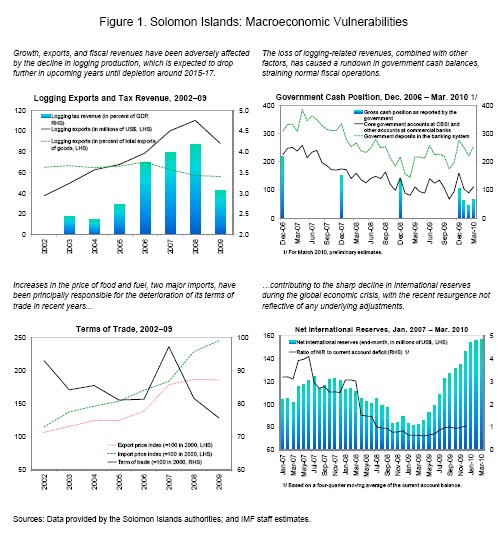
IMF Advice to Solomon Islands on Growth


Still the standard advice is more structural reforms;

The authorities’ acknowledge that further progress on the agenda of structural reform is needed to strengthen medium-term growth prospects. They intend to build on the steps taken to commercialize operations in stateowned enterprises; improve competitiveness, including the deregulation of telecommunications; and reduce the cost of doing business through revision of the legal framework.

In view of the adverse impact of the global economic downturn, the key objective of the authorities’ economic reform program is to establish a basis for resuming solid growth and reducing external vulnerability in a low-inflation environment, while advancing poverty alleviation efforts. To this end, the program seeks to strengthen the fiscal position, enhance monetary policy operations, and safeguard the domestic financial sector. By laying a strong macroeconomic foundation, the program is also expected to help catalyze additional donor support for the country.

Fiscal discipline will continue to serve as the main anchor for macroeconomic stability. Efforts will focus on rebuilding cash reserves mainly by strengthening revenue collection and prioritizing expenditure. Adopting a fiscal responsibility law and devising a proper resource tax regime would help enhance budget discipline, improve revenue transparency, and ensure a sustainable fiscal path.

“The current monetary stance is broadly appropriate, and sufficiently accommodative to support economic recovery. The program seeks to strengthen the operational framework of monetary policy and introduce new policy instruments to help banks manage liquidity, ensuring long-term price stability.

Monday, October 25, 2010

What's Job Generating Growth

Economic Prospects for Middle East, North Africa and Afghanistan and Pakistan (MENAP).

The report recommended that policymakers in MENAP’s oil importers focus on the following priorities:
• Raising growth to generate employment. During the past two decades, per capita growth among the oil importers has been substantially lower than in other emerging markets, mirroring a weak trade performance (see Chart 2). Faced with already high unemployment—an average of 11 percent in 2008—the challenge for the oil importers will be to raise growth to provide employment for a working age population that is growing faster than in almost all other regions. To absorb the currently unemployed and new labor market entrants over the next decade (and assuming that the ratio of jobs created to economic growth remains constant), annual growth would need to reach 6½ percent.

• Enhancing competitiveness. MENAP oil importers—many of which face burdensome regulatory systems, weak institutions, and a dominating public sector—have much to accomplish to become competitive relative to other more dynamic economies. Sound macroeconomic policies—in particular, fiscal consolidation—will help support competitiveness, but governments will also need to make greater efforts to improve the business climate.

• Fostering trade. The region’s trading patterns remain oriented mainly toward Europe, and there has been relatively little change in the product mix. Although there has been some diversification of trade links, the region has benefited relatively little from the expansion of Asian and Latin American powerhouses—which contribute close to half of global GDP growth, but account for only about 9 percent of the region’s total exports.

Tuesday, July 13, 2010

Albania - V Shaped Recovery ahead


IMF Article IV Staff Report on Albania is released;

Outlook: The baseline is for a V-shaped recovery, albeit to a lower potential growth than before the crisis, with low inflation and external imbalances narrowing. However, downside risks are significant
and elevated budget financing requirements under unchanged policies will crowd out private investment,thereby undermining potential growth over the medium term.

Policy Discussions: A tighter fiscal stance with improvements in productivity and competitiveness is a superior adjustment strategy, and consolidation could serve to enhance, rather than damage, growth
prospects. The authorities’ fiscal adjustment strategy is based on over-optimistic revenue and growth expectations. There was agreement of the benefits of a clear, credible, and monitorable fiscal rule to safeguard fiscal sustainability. Monetary policy should remain cautious and supervisors remain vigilant, given heightened regional uncertainty. Improvements in the business environment are critical to harvest the benefits from closer EU integration.


Links on Albanian data:
Ministry of Finance
Bank of Albania

Ministry of Economy, Trade and Energy

Institute of Statistics