Showing posts with label Growth Diagnostics. Show all posts

Monday, February 7, 2011

Egypt - Binding Constraints to Growth

The foregoing review of the literature and relevant facts on constraints to growth in Egypt suggests a short list of prime suspects that may deserve deeper investigation(Figure 10). Access to financing, notably, does not appear to be the main recent or current obstacle to growth; real interest rates would be much higher and the external current account under greater pressure if indeed businesses were strongly competing for funding of an abundance of profitable investment ideas. At the same time, there is a question of whether the limited available data really tell the full story: business complaints about lack of access to financing may reflect some nonprice rationing of credit, especially through the state banks, and access to finance for small enterprises and farmers may constitute a binding growth constraint for that sector. The latter would reflect the inefficiency of the financial system in allocating savings to domestic investments rather than lack of domestic or foreign savings, but also capacity constraints on borrowers. The ongoing reform of the financial sector (which by late 2006 had shifted more than half of the banking sector to private ownership, along with governance reform at the remaining state banks and more generally a modernization and liberalization of financial institutions) thus tackles a constraint that would probably become binding soon. But ongoing growth and rising investments may also move the economy, in the near future, to a point where low national savings (reflecting high public dissavings) constitute a critical constraint, unless access to foreign savings (notably higher FDI dedicated to greenfield investments rather than one-off privatizations) could be durably expanded.

32. There is considerable evidence, including surveys and comparative rankings, as well as Egypt’s difficulty in moving toward new higher value-added products, pointing to appropriability of returns as a critical constraint. Private returns are reduced through the high cost imposed by complex regulations and inefficient government services, but perhaps also through the high cost of experimenting and exploring new production ideas. Recent bold reforms have focused on this area, particularly in the tax system and trade regulations, and the concomitant pick-up in growth is consistent with the view that these reforms have been addressing critical constraints. By contrast, a dearth of complementary factors does not appear among the prime suspects of having held up growth—though, again, there is little doubt that over the longer run, and as sophistication in the economy increases, Egypt will need to bolster its human capital if it wants to continue growing.

33. The authorities have started to tackle the high fiscal deficit with a view to halving it to around 4 percent of GDP by 2010, and thus bringing public debt onto a declining trajectory. As indicated above, implementing this plan would help forestall potential debt overhang effects, contribute to greater efficiency of financial intermediation, and help raise national savings—all potential, if not actual, constraints on growth.

34. Overall, the Egyptian reforms launched in 2004 appear remarkably apt at focusing on the most critical constraints and thus maximizing the growth effect out of a limited set of reforms. Since removing the most critical constraint is likely to give both the fastest and the biggest “bang for the buck,” the strategy might also have been the politically most feasible approach, maximizing the return on political capital which, for any government, is always limited. Further reforms aimed at easing the cost of regulations will likely continue to have high payoffs. Increasingly, however, reforms with different political economy characteristics, such as revamping education or reigning in the fiscal deficit, will become the critical challenge. Since these steps take more time (for design, political consensus building, implementation, and pay-off) the authorities are well advised to use the tailwinds generated by the recent reforms to start tackling these more distant constraints. This would reduce the risk that the recent growth episode will become another tale of a growth spurt that fizzled out because some deeper constraints were not addressed.

35. As the various reforms unleash entrepreneurial spirit and investment in Egypt, more attention may also have to be paid to potential pitfalls highlighted by the “Theory of Second Best.” For example, with energy highly subsidized, and energy prices in Egypt among the lowest in the world, lifting financing constraints or raising private returns on investment may trigger higher investment in energy-intensive activities that may not optimize social returns. As highlighted at the beginning, there may be no escaping the fact that, while a few simple bold measures can work wonders for a while, sustaining growth will require reforms along many dimensions and paying attention to the complex interaction among them
-Egypt--Searching for Binding Constraints on Growth

Saturday, January 15, 2011

Trinidad and Tobago- Dual Economy Growth Diagnostic

In the case of a dual, natural resource abundant economy such as Trinidad & Tobago’s, an aggregate view is not enough to understand the growth opportunities and binding constraints: we need to stress the growth opportunities of each sector and their interactions, since the
constraints may be different for non-energy and energy activities.

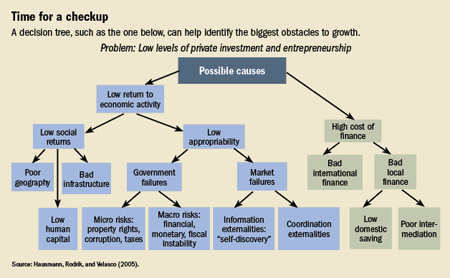
A major concern for Trinidad & Tobago is the diversification of economic activity, and preparing for the time when oil and gas reserves are depleted. The binding constraints to growth in the non-energy sector in Trinidad & Tobago are outlined in the following growth diagnostic tree. The rest of this work will attempt to identify which of these potential constraints to growth are binding.
-Trinidad & Tobago: Economic Growth in a Dual Economy

Tuesday, November 30, 2010

Self Discovery in Togo- Not binding?

Self-discovery refers to the process of identifying industries with potential but as of yet unrealized comparative advantage. Private entrepreneurs may be reluctant to accept the risks involved in developing new products or industries if they fear that others will quickly imitate their activity and eliminate the profits necessary to offset the initial investments and risks. Historical export data from the country in question, as well as in other countries at similar income levels, can be used to infer likely opportunities for export diversification and growth (Klinger and Lederman 2006, Hausmann et al. 2005, Hausmann and Klinger 2006, and Klinger and Lederman 2006). This literature uses the concept of revealed comparative advantage (RCA) over time, e.g. changes in export composition between different periods, to assess the dynamism of a country’s exports. Exports of particular commodities can also be assessed in terms of their growth potential, by examining the income levels of other countries that export this and similar products. That is, products typically exported by high-income countries are assumed to be more beneficial for generating growth than products typically exported by low-income countries.

The turnover in exports suggests that self-discovery is not a binding constraint to growth in Togo. About 20 percent of Togo’s exports comprising 31 product groups at the 3-digit SITC level have emerged only since 2000, suggesting that some innovation is taking place. Exports of this group have increased 14.5 percent between 1992-96 and 2002-06. The “implied income” associated with this export basket, when looking at other countries exporting the same products, was 30 percent above that of the traditional exports of Togo.
-Togo - Reviving the traditional sectors and preparing for the future : an export-led growth strategy - country economic memorandum

Tuesday, November 16, 2010

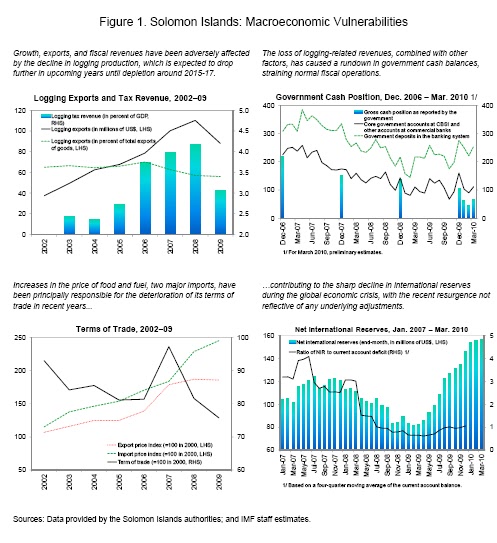
IMF Advice to Solomon Islands on Growth


Still the standard advice is more structural reforms;

The authorities’ acknowledge that further progress on the agenda of structural reform is needed to strengthen medium-term growth prospects. They intend to build on the steps taken to commercialize operations in stateowned enterprises; improve competitiveness, including the deregulation of telecommunications; and reduce the cost of doing business through revision of the legal framework.

In view of the adverse impact of the global economic downturn, the key objective of the authorities’ economic reform program is to establish a basis for resuming solid growth and reducing external vulnerability in a low-inflation environment, while advancing poverty alleviation efforts. To this end, the program seeks to strengthen the fiscal position, enhance monetary policy operations, and safeguard the domestic financial sector. By laying a strong macroeconomic foundation, the program is also expected to help catalyze additional donor support for the country.

Fiscal discipline will continue to serve as the main anchor for macroeconomic stability. Efforts will focus on rebuilding cash reserves mainly by strengthening revenue collection and prioritizing expenditure. Adopting a fiscal responsibility law and devising a proper resource tax regime would help enhance budget discipline, improve revenue transparency, and ensure a sustainable fiscal path.

“The current monetary stance is broadly appropriate, and sufficiently accommodative to support economic recovery. The program seeks to strengthen the operational framework of monetary policy and introduce new policy instruments to help banks manage liquidity, ensuring long-term price stability.

Binding Constraints for Growth in Solomon Islands

Interesting report on regenerating growth in Solomon Islands-

The report warns that examples of rapid and sustained economic growth globally are rare. The Pacific Island Countries face particular disadvantages, due to their small size and large distance to major markets. Solomon Islands may face especially severe constraints, as its scattered population reduces access to infrastructure and increases the costs of transport.

"Solomon Islands faces economic challenges, but growth prospects are reasonable if Solomon Islands plays to its existing advantages and capabilities," said Doug Porter, who led the study.

The report states that prospects for economic development in Solomon Islands will be significantly improved if four key potential sources of growth are prioritized. These areas include:

-Increasing productivity in agricultural production, on which most Solomon Islanders will continue to rely
-Ensuring that major natural resource industries - including mining and tourism – are well regulated, so that benefits flow to Solomon Islanders
-Increasing labor mobility, with Solomon Islanders having increased opportunities to acquire skills and incomes from work in Australian, New Zealand and other overseas economies.
-Improving the administration of aid, with more predictable flows of resources and capacity, with mutual accountability for results.
According to the report, economic growth is likely to be concentrated in urban centers, areas of high agricultural production, and areas with natural resource potential.

"However benefits can be shared throughout the country if efforts are made to connect rural populations to urban markets, and carefully target investment in services and infrastructure where economic activity and population are concentrated," said Doug Porter.

Related:
Solomon Islands Sources of Growth
Key Findings Summary

Wednesday, September 22, 2010

El Salavador's Eternal Binding Constraints

Perhaps the most telling indicator that El Salvador is not constrained by a lack of savings is that a dramatic boost in remittances has not been converted into investment. This suggests that the country invests little, not because it cannot mobilize resources (though savings are low) but because it cannot find productive investments.

IMF latest review of El Salvardor economy;

Over the longer term, further strengthening the economy’s growth prospects and reducing poverty, while safeguarding fiscal sustainability, requires a comprehensive strategy, including measures to raise revenues, structural reforms aimed at enhancing the business climate, and higher private investment...

The authorities’ strategy for 2011, which includes strengthening tax administration to increase revenues as well as reforming energy subsidies, will create space for high-priority social spending and public investment while lowering the fiscal deficit to 3.5 percent of GDP.

“Beyond 2011, timely enactment of a fiscal pact, which includes measures to raise revenue on a durable basis, and continued adherence to expenditure targets in the authorities’ program will be critical to sustain fiscal consolidation, placing the debt-to-GDP ratio on a firm downward path.

“Continued commitment to the dollarization regime has been the cornerstone of macroeconomic and financial stability. While the Salvadoran banking system is liquid and well-capitalized, it would benefit from further reforms aimed at enhancing its resilience. Approving the Financial Sector Supervision and Regulation Law, bolstering the corporate governance of banks, and upgrading the bank resolution framework will be key to this objective. Limiting the fiscal risks associated with the provision of credit by public banks will also be necessary,” Mr. Shinohara said.

Sunday, August 1, 2010

Lack of Self Discovery in Italy

An interesting piece on problems with Italian economy;

Study the numbers and you will find symptoms of distress that look a lot like those of Greece. Public sector debt amounts to roughly 118 percent of the gross domestic product, nearly identical to Greece. And like Greece, Italy is trying to ease fears in the euro zone and elsewhere with an austerity package, one intended to cut the deficit in half, to 2.7 percent of G.D.P., by 2012.

But dig a little deeper and the similarities end. The Italians, unlike the Greeks, are born savers, and much of the Italian debt is owned by the Italians. That means that unlike Greece, which will be sending a sizable percentage of its G.D.P. to foreign creditors for a generation to come, Italy is basically in hock to its own citizens.

“I know that in the States, all Mediterranean countries get lumped together,” says Carlo Altomonte, an economist with Bocconi University in Milan. “But Italy’s problem isn’t that we have a lot of debt. It’s that we don’t grow.” ...

But sales for Luciano Barbera clothing and Carlo Barbera fabric have drastically slowed in recent years. In the late ’90s, the mill enjoyed record annual sales of what amounts to about $15.5 million, Mr. Barbera says. Last year, the figure was half that sum.

WHEN describing the ills of his businesses, Mr. Barbera tends to focus on one issue: the “Made in Italy” label. For the last decade, he says, a growing number of clothing designers have been buying cheaper fabric in China, Bulgaria and elsewhere and slapping “Made in Italy” on garments, even if those garments are merely sewn here.

Until recently, there weren’t any rules about what “Made in Italy” actually meant, but that will change when a new law goes into effect in October. It states that if at least two stages of production — there are four stages altogether — occur in Italy, a garment is made in Italy....

To understand why his factory, and so much of Italy, is stagnant or worse, requires a bit of geopolitical history and a look at the highly idiosyncratic business culture here. It is defined, to a large degree, by deep-seated mistrust — not just of the government, but of anyone who isn’t part of the immediate family — as well as a widespread aversion to risk and to growth that to American eyes looks almost quaint...

FIVE years ago, Francesco Giavazzi needed a taxi. Cabs are relatively scarce in Milan, especially at 5 a.m., when he wanted to head to the airport, so he called a company at 4:30 to schedule a pickup. But when he climbed into the cab half an hour later, he discovered that the meter had been running for more than 20 minutes, because the taxi driver had arrived soon after the call and started charging for his time. Allowed by the rules, but to Mr. Giavazzi, utterly unfair.

“So it was 20 euros before we started the trip to the airport,” recalls Mr. Giavazzi, who is an economics professor at Bocconi University. “I said, ‘This is impossible.’ ”

Professor Giavazzi later wrote an op-ed article denouncing this episode as another example of the toll exacted by Italy’s innumerable guilds, known by several names here, including “associazioni di categoria.” (These are different from unions, another force here, in that guilds are made up of independent players in a trade or profession who have joined to keep outsiders out and maintain standards, as opposed to representing employees in negotiations with management, as a union might.) Even baby sitters have associations in Italy.

The op-ed did not endear Professor Giavazzi to the city’s cab drivers. They pinned leaflets with his name and address at taxi stands around Milan and for the next five nights, cabs drove around his home, honking their horns.

“This is a country with a lot of rents,” says Professor Giavazzi, sitting in his office one recent afternoon, using the economists’ term for excess profits that flow to a business because of a lack of competition. “You need a notary public, it’s like 1,000 euros before you even open your mouth. If you’re a notary public in this country, you live like a king.”...

Roughly one-quarter of Italy’s G.D.P. is off the books. When you inquire about the cause and persistence of this longstanding fact of life, people here say that most Italians have little sense of national identity, an obstacle to a system of national taxation. The country didn’t really begin to transcend its clannish roots and regional dialects until after World War II; even today, displays of national pride are reserved for World Cup victories and little else.

Italians, notes Professor Altomonte, are among the world’s heaviest consumers of bottled water. “Do you know why? Because the water in the tap comes from the government.”...

The suspicion of Italians when it comes to extra-familial institutions explains why many here care more about protecting what they have than enhancing their wealth. Most Italians live less than a mile or two from their parents and stay there, often for financial benefits like cash and in-kind services like day care. It’s an insularity that runs all the way up to the corporate suites. The first goal of many entrepreneurs here isn’t growth, so much as keeping the business in the family. For a company to really expand, it needs capital, but that means giving up at least some control. So thousands of companies here remain stubbornly small — all of which means Italy is a haven for artisans but is in a lousy position to play the global domination game...

To Professor Giavazzi, the future here doesn’t look like Greece. It looks like Argentina.

“Before World War II, Argentina was rich,” he says. “Even in 1960, the country was twice as rich as Italy.” Today, he says, you can compare the per capita income of Argentina to that of Romania. “Because it didn’t grow. A country could get rich in 1900 just by producing corn and meat, but that is not true today. But it took them 100 years to realize they were becoming poor. And that is what worries me about Italy. We’re not going to starve next week. We are just going to decline, slowly, slowly, and I’m not sure what will turn that around.”
-Is Italy Too Italian?

Friday, May 21, 2010

What are binding constraints to growth in Fiji?

Is land reform the most binding constraint to growth in Fiji?

A comprehensive package of structural reforms is being prepared by the authorities to spur growth and create jobs. This includes reforms to the civil service, public enterprises, public pension fund, and land-lease system—together with price liberalization. Staff noted the importance of well designed reforms to lift potential growth...

Land tenure reform is a key priority of the Government’s reform agenda. It is also an area that Staff and other multilateral institutions also consider as vital to raising the economic growth potential of the economy given large areas of unutilized arable land. The Government has formed a task force that will facilitate utilization of idle land for productive use. Land will be available for leases under this effort from the first quarter of 2010.


For Discussion: What do you think are the binding constraints to growth in Fiji?


Related:
Fisheries in the Economies of the Pacific Island Countries and Territories

Finding Balance-Making State-Owned Enterprises Work in Fiji, Samoa, and Tonga

IMF loan for Fiji seen as long-term liability

Doing Business - Fiji

WDI -Fiji

Binding Constraints in the Pacific

Saturday, April 24, 2010

Broadband and Growth


The World Bank has found that in low- and middle-income countries every 10 percentage point increase in broadband penetration accelerates economic growth by 1.38 percentage points—more than in high-income countries and more than for other telecommunications services (Figure 1).16 In a similar study, McKinsey & Company estimates that ―a 10 percent increase in broadband household penetration delivers a boost to a country‘s GDP that ranges from 0.1 percent to 1.4 percent. Booz & Company found that ―10 percent higher broadband penetration in a specific year is correlated to 1.5 percent greater labor productivity growth over the following five years.Booz also suggests that ―countries in the top tier of broadband penetration have exhibited 2 percent higher GDP growth than countries in the bottom tier. These studies are the latest in the already extensive work estimating broadband‘s economic impact.

Developing other elements of the broadband ecosystem also provides economic benefits. For example, the growth of Internet-related services and applications has created jobs and led to the creation of new businesses. For example, in November 2009 Google had a market capitalization of $168 billion and employed 19,000 people in 20 countries. China‘s leading Internet search engine, Baidu.com, has a market capitalization of more than $14 billion and over 6,000 employees, and in 2008 had revenues of $460 million.

Developers have also been extremely active in creating applications for various handsets. Annual sales of applications for Apple‘s iPhone exceed $2.4 billion, as well as stimulating additional hardware sales. Thus broadband creates significant economic opportunities for users, service providers, application developers, and network operators alike. McKinsey estimates that ―bringing broadband penetration levels in emerging markets to today‘s Western European levels could potentially add US$300–420 billion in GDP and generate 10–14 million jobs.

-Building broadband: Strategies and policies for the developing world