Something for Nothing-A Novel
Michael W. Klein
David Fox (Ph.D. Economics, Columbia, Visiting Assistant Professor at Kester College, Knittersville, New York) is having a stressful year. He has a temporary position at a small college in a small town miles from everything except Albany. His students have never read Freakonomics. He thinks he is getting the hang of teaching, but a smart and beautiful young woman in his Economics of Social Issues class is distractingly flirtatious. His research is stagnant, to put it kindly. His search for a tenure-track job looms dauntingly. (The previous visiting assistant professor of economics is now working in a bookstore.) So when a right-wing think tank called the Center to Research Opportunities for a Spiritual Society (CROSS)--affiliated with the Salvation Academy for Value Economics (SAVE)--wants to publish (and publicize) a paper he wrote as a graduate student showing the benefits of high school abstinence programs, fetchingly retitled "Something for Nothing," he ignores his misgivings and accepts happily. After all, publication is “the coin of the realm,” as a senior colleague puts it.
But David faces a personal dilemma when his prized results are cast into doubt. The school year is filled with other challenges as well, including faculty politics, a romance with a Knittersville native, running the annual interview gauntlet, and delivering the culminating "job talk" lecture under trying circumstances. David’s adventures offer an instructive fictional guide for the young economist and an entertaining and comic tale for everyone interested in questions of balancing career and life, success and integrity, and loyalty and desire.
Showing posts with label Economic Literacy. Show all posts
Showing posts with label Economic Literacy. Show all posts
Tuesday, September 6, 2011
Something for Nothing

Friday, August 5, 2011
Friday, November 12, 2010
Book Recommendation- Growth and Natural Resource exploitation

Edward B. Barbier, University of Wyoming
Throughout much of history, a critical driving force behind global economic development has been the response of society to the scarcity of key natural resources. Increasing scarcity raises the cost of exploiting existing natural resources and creates incentives in all economies to innovate and conserve more of these resources. However, economies have also responded to increasing scarcity by obtaining and developing more of these resources. Since the agricultural transition over 12,000 years ago, this exploitation of new 'frontiers' has often proved to be a pivotal human response to natural resource scarcity. This book provides a fascinating account of the contribution that natural resource exploitation has made to economic development in key eras of world history. This not only fills an important gap in the literature on economic history but also shows how we can draw lessons from these past epochs for attaining sustainable economic development in the world today.
Tuesday, September 14, 2010
Friday, September 3, 2010
Mankiw and Arnold's Freshmen Seminar
Mankiw's list;
Arnold Kling's list;
1. Jerry Muller, The Mind and the Market.
2. Robert Frank The Economic Naturalist.
3. Carl Shapiro and Hal Varian, Information Rules.
4. Matt Ridley, The Rational Optimist.
5. Kevin Lang, Poverty and Discrimination.
6. Ed Leamer, Macroeconomic Patterns and Stories.
7. Burton Malkiel, A Random Walk Down Wall Street.
8. Tyler Cowen, The Age of the Infovore.
The Worldly Philosophers, by Robert Heilbronr
Reinventing the Bazaar: A Natural History of Markets, by John McMillan
Thinking Strategically, by Avinash Dixit and Barry Nalebuff
Capitalism and Freedom, by Milton Friedman
Equality and Efficiency: The Big Tradeoff, by Arthur Okun
Nudge, by Richard Thaler and Cass Sunstein
How the Economy Works, by Roger E.A. Farmer
The Return of Depression Economics, by Paul Krugman
The Road to Serfdom, Friedrich Hayek
The Myth of the Rational Voter, by Bryan Caplan
The Big Questions, by Steven Landsburg
Arnold Kling's list;
1. Jerry Muller, The Mind and the Market.
2. Robert Frank The Economic Naturalist.
3. Carl Shapiro and Hal Varian, Information Rules.
4. Matt Ridley, The Rational Optimist.
5. Kevin Lang, Poverty and Discrimination.
6. Ed Leamer, Macroeconomic Patterns and Stories.
7. Burton Malkiel, A Random Walk Down Wall Street.
8. Tyler Cowen, The Age of the Infovore.
Tuesday, August 31, 2010
Two Book Recommendations
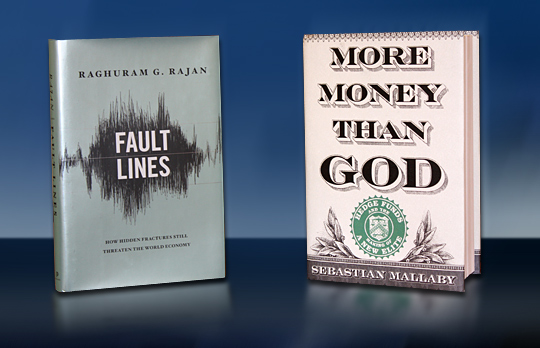
Related:
Predicting the Financial Crisis: A Q&A With Fault Lines Author Raghuram Rajan
Sunday, August 29, 2010
Friday, July 9, 2010
Economic Literacy with Cartoons
One way being tried to improve economic literacy in Poland;
Related:
Civil Development Forum
Polish Central Bank's Economic Education Portel;
Last year, for instance, the "inflation" prize went to a three-page comic strip about a king who was so prodigal when it came to reimbursing dragon-slayers for their services with his daughters' hand in marriage that soon an apple would set you back twelve and a half units of royal female progeny.Presenting economic principles in quirky comic form has clearly struck a chord, especially with children who adore the genre. Economists the world over bemoan their compatriots' dismal grasp of the dismal science. Implemented on a large scale, FOR's idea could help fix that.

Related:
Civil Development Forum
Polish Central Bank's Economic Education Portel;
* Distance learning - comprehensive multimedia e-learning courses, accompanied by illustrations, animation clips, and films.
* Teacher's Centre - a service designed for teachers of economics or economics-related subjects at lower and upper secondary schools in Poland. It contains teaching aids in the form of ready-to-use lesson plans, and practical tips on efficient and unconventional methods of conducting lessons.
* Fun - numerous decision-making quizzes, skill-enhancing and strategic games, crossword puzzles, and jigsaws. This part of the portal has been created for those who want to acquire basic information on economics while having fun.
* Knowledge Mines - made of two parts: the Virtual Library, and the glossary of economic terms. The Virtual Library contains electronic versions of academic publications, including the Bank's publications, as well as publications by external institutions co-operating with NBPortal.pl. The glossary features over a thousand entries, explaining the meaning of economic terms.
* News - both business headlines and larger articles and papers, presenting current economic and business issues in an intelligible way.
Friday, June 25, 2010
JEP is liberated
Journal of Economic Perspectives is now available to anyone on line, for free, going back to 1999
via Arnold Kling
Book Recommendation- Uncommon Sense

Gary S. Becker and Richard A. Posner
The Chapters will give you a flavor;
I. Sex and Population
1. The Sexual Revolution
2. Gay Marriage
3. Polygamy
4. Sex Selection
5. Immigration Reform
6. Putin’s Population Plan
II. Property Rights
7. Kelo and Eminent Domain
8. Pharmaceutical Patents
9. Grokster, File Sharing, and Contributory Infringement
10. Orphan Drugs, Intellectual Property, and Social Welfare
11. Organ Sales
12. Traffic Congestion
13. Privatizing Highways
III. Universities
14. Plagiarism
15. Tenure
16. For-Profit Colleges
17. Ranking Higher Education
IV. Incentives
18. Fat Tax
19. Trans Fats Ban
20. Libertarian Paternalism
21. Chicago and Big Boxes
V. Jobs and Employment
22. Judicial Term Limits
23. Economics of the Revolving Door
24. CEO Compensation
25. Income Inequality
26. Corporate Social Responsibility
VI. Environment and Disasters
27. Tsunami
28. Major Disasters
29. Federalism, Economics, and Katrina
30. Post-Catastrophe Price Gouging
31. Global Warming and Discount Rates
32. Efficient Water Conservation
VII. Crime and Punishment and Terrorism
33. Capital Punishment
34. Doping Athletes
35. Drunk Driving
36.Internet Gambling
37. Preventive War
38. Ethnic Profiling
39. Privatizing Security
40. Antiterrorism Allocations
41. Collective Punishment
VIII. The World
42. Economic and Political Freedom
43. Size of Countries
44. Hamas, Palestine, and Democracy
45. Google in China
46. Economics of National Culture
47. Microfinance and Development
48. World Inequality
49. Foreign Aid
Saturday, December 19, 2009
Assorted Economic Literacy
What Is the Price Elasticity of Demand for the H1N1 Vaccine?
What's the price elasticity of college in Pittsburgh?
Sen. Vitter Presents End-of-Term Exam For Bernanke
Nine Observations about Investment
The last of the great general economists died on December 13th, aged 94
What is it with Microeconomists?
What's the price elasticity of college in Pittsburgh?
Sen. Vitter Presents End-of-Term Exam For Bernanke
Nine Observations about Investment
The last of the great general economists died on December 13th, aged 94
What is it with Microeconomists?
Sunday, March 29, 2009
David Leonhardt- your favorite economics columnists
"After the Recession: Can the Obama Administration Fix the Economy?"-David Leonhardt
Wednesday, March 25, 2009
Media on Macroeconomic Management
In Ten Trillion and Counting, FRONTLINE traces the politics behind this mounting debt and investigates what some say is a looming crisis that makes the current financial situation pale in comparison.
The other documentary that came out last year
I.O.U.S.A.
The other documentary that came out last year
I.O.U.S.A.
Subscribe to:
Posts (Atom)


.png)